Research welfare
Track participant welfare in the trial
- Obtain ethics approval before fieldwork
- Monitor wellbeing throughout the trial
- Severe depression: remove and refer
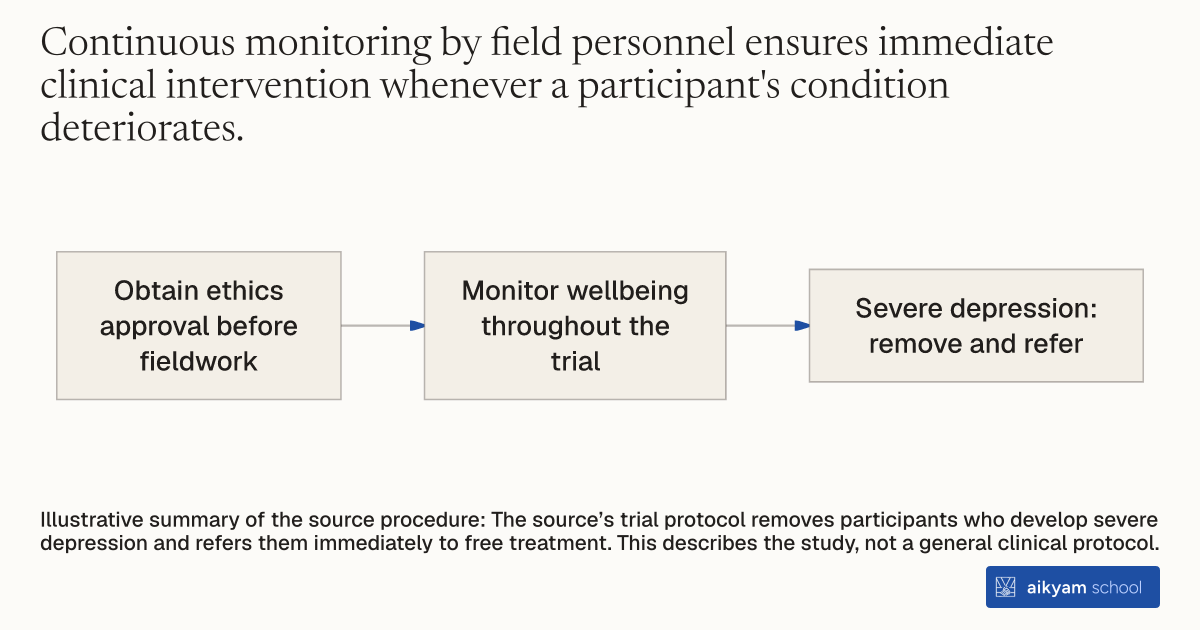
Illustrative summary of the source procedure: The source’s trial protocol removes participants who develop severe depression and refers them immediately to free treatment. This describes the study, not a general clinical protocol.
See source →How
When to use
In field evaluations involving human subjects with psychiatric disorders, participants face risks of severe psychological distress or worsening illness during the study period. Implementing a structured participant welfare protocol establishes ongoing health monitoring and emergency referral mechanisms. This protects vulnerable adults suffering from depression while maintaining ethical compliance across community-based field trials.
Establish participant welfare monitoring protocols to track health conditions and provide clinical care referrals during community health trials.
- Institutional review boards review and approve evaluation procedures and ethical protocols before fieldwork begins.
- Field staff and partner organization personnel monitor the wellbeing of trial participants throughout the evaluation period.
- Staff assess participants during regular interactions to detect worsening psychiatric symptoms or severe depression.
- Staff remove any participant who begins experiencing severe depression from the study cohort.
- Staff refer identified individuals immediately to free clinical treatment for medical care.
Why it works
Removing severely depressed individuals from research procedures and directing them to free treatment prevents harm while upholding participant safety.
Example
Researchers and GASS personnel monitored 1,000 adults with mild or moderate depression across 506 villages near Bangalore, India, securing institutional review board approval and removing participants who developed severe depression to provide immediate free medical care.
About the study
Participants
1,000 adults with mild or moderate depression symptoms (86 percent women) across 506 villages near Bangalore, India.
Study Design
Ethical oversight protocol integrated into a four-arm randomized evaluation, requiring continuous wellbeing monitoring by research staff and GASS personnel across five survey waves over 26 months.
Results
Ethical monitoring protocols ensured participant safety across 1,000 adults, removing participants experiencing severe depression from the study and connecting them to immediate free medical treatment.