Try, learn and adjust
Check every provider receives maternity guidelines
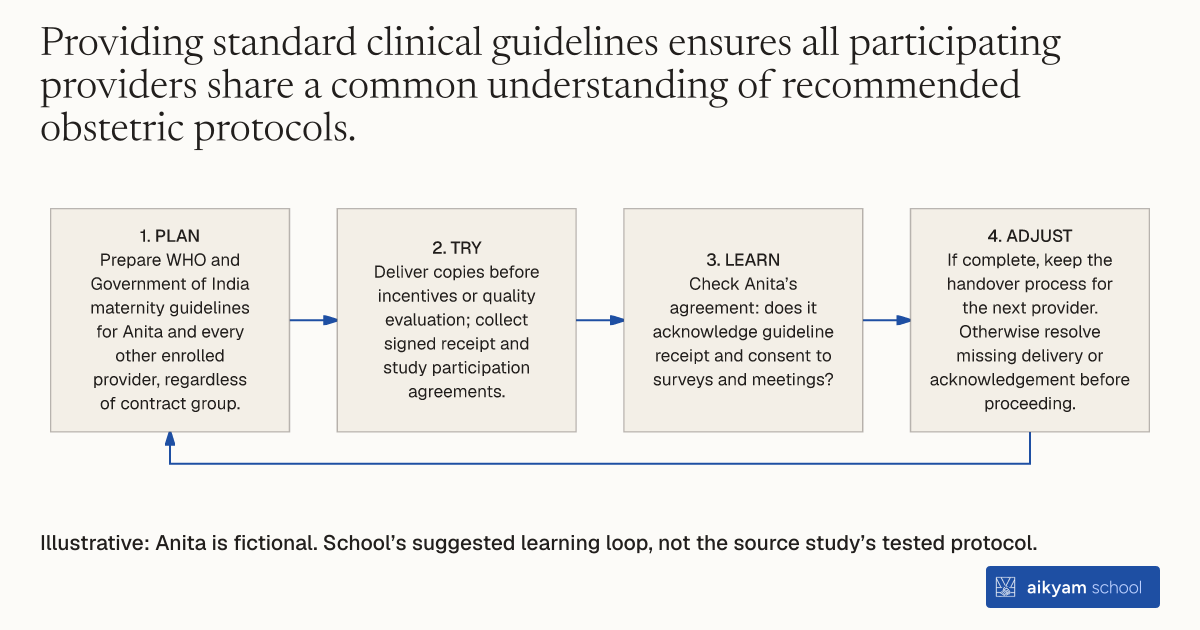
- Plan: Prepare WHO and Government of India maternity guidelines for Anita and every other enrolled provider, regardless of contract group.
- Try: Deliver copies before incentives or quality evaluation; collect signed receipt and study participation agreements.
- Learn: Check Anita’s agreement: does it acknowledge guideline receipt and consent to surveys and meetings?
- Adjust: If complete, keep the handover process for the next provider. Otherwise resolve missing delivery or acknowledgement before proceeding.
Illustrative: Anita is fictional. School’s suggested learning loop, not the source study’s tested protocol.
See source →Observe guideline receipt and signed participation agreements. This check does not establish clinical quality. School’s suggested learning loop; not a tested source procedure.
How
When to use
Healthcare providers in low-resource settings often vary in their adherence to standardized clinical protocols during childbirth. Program managers need a baseline strategy to establish clear care standards across treatment and comparison groups. Distributing official maternal care protocols ensures all participating practitioners receive identical benchmark guidelines.
Distribute official World Health Organization and national clinical guidelines to all participating healthcare providers prior to implementing financial incentives or quality evaluations.
- Program administrators gather official World Health Organization (WHO) and Government of India best practice guidelines for maternity care.
- Field staff deliver copies of the maternity care guidelines to every enrolled healthcare provider regardless of contract group assignment.
- Program managers collect signed agreements from participating providers acknowledging receipt of guidelines and consenting to program surveys and meetings.
- Clinicians review the standard guidelines to align their delivery and obstetric practices with recommended clinical protocols.
Why it works
Establishing a shared information baseline separates the educational impact of clinical standards from the behavioral effects of financial incentive structures.
Example
Researchers provided World Health Organization and Government of India maternity care guidelines to all 135 participating private obstetric care providers across incentive and control groups in rural Karnataka, India.
About the study
Participants
135 participating private obstetric care providers and 2,895 mothers who recently gave birth across rural Karnataka, India.
Study Design
Randomized evaluation where all 135 providers received WHO and Government of India maternity guidelines, while subsets received input-based reward contracts (38 providers), output-based reward contracts (53 providers), or no financial incentives (44 providers).
Results
Delivering guidelines alone to the 44 comparison group providers resulted in high baseline usage for certain inputs, such as 99 percent glove use, though financial incentive contracts further reduced postpartum hemorrhage by 20 to 23 percent.