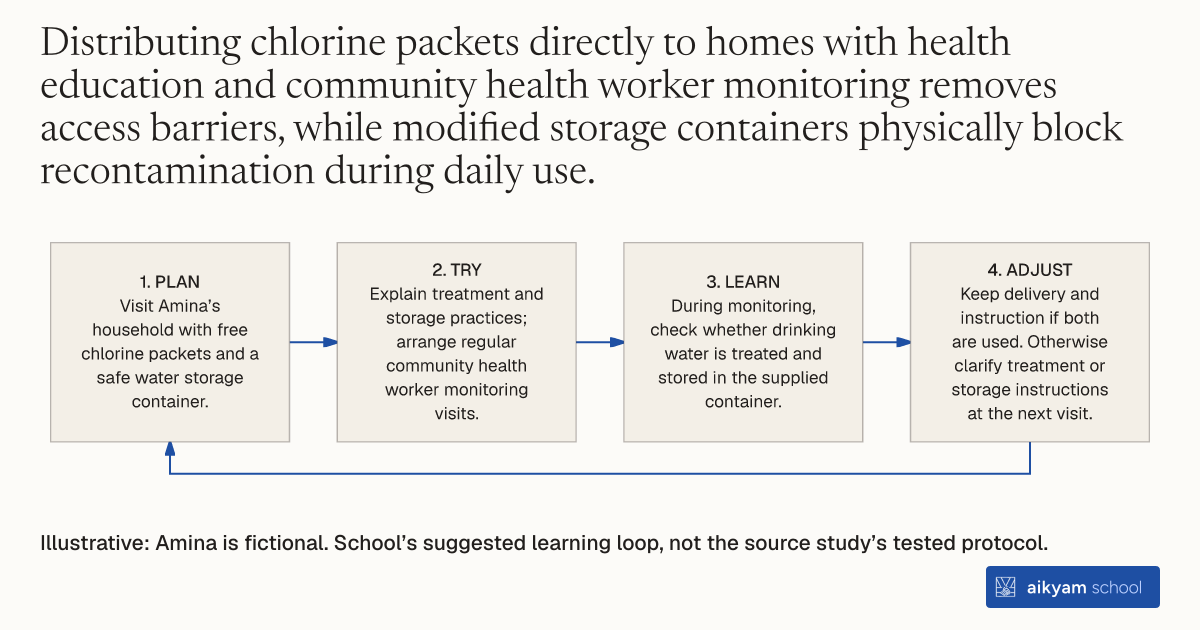
Try, learn and adjust
Check household water treatment and safe storage
- Plan: Visit Amina’s household with free chlorine packets and a safe water storage container.
- Try: Explain treatment and storage practices; arrange regular community health worker monitoring visits.
- Learn: During monitoring, check whether drinking water is treated and stored in the supplied container.
- Adjust: Keep delivery and instruction if both are used. Otherwise clarify treatment or storage instructions at the next visit.
Illustrative: Amina is fictional. School’s suggested learning loop, not the source study’s tested protocol.
See source →School’s suggested, untested loop: observe treatment and storage practices. The source evaluated chlorine, containers, information and monitoring together.
How
When to use
Many households in low- and middle-income settings consume water that is contaminated at the source or during household storage. Providing free point-of-use water treatment products directly to homes eliminates financial and access barriers. Combining chlorine packets with modified safe storage containers protects drinking water from initial pathogens and subsequent recontamination.
Distribute free chlorine packets door-to-door alongside safe water storage containers and health education.
- Visit target households door-to-door to distribute free packets of chlorine water treatment.
- Provide each household with a specialized storage container designed to prevent water recontamination.
- Deliver health information explaining proper water treatment and safe storage practices.
- Assign community health workers to conduct regular household monitoring visits.
- Instruct residents to treat collected drinking water with chlorine packets inside the provided safe storage container.
Example
In Karachi, Pakistan, distributing free chlorine packets door-to-door alongside information, CHW monitoring, and improved storage containers decreased bacterial contamination by 99.8 percent compared to 8 percent in the comparison group, preventing 115 diarrheal incidents per 1,000 US dollars spent.