Try, learn and adjust
Check agreed birth-attendant referral roles
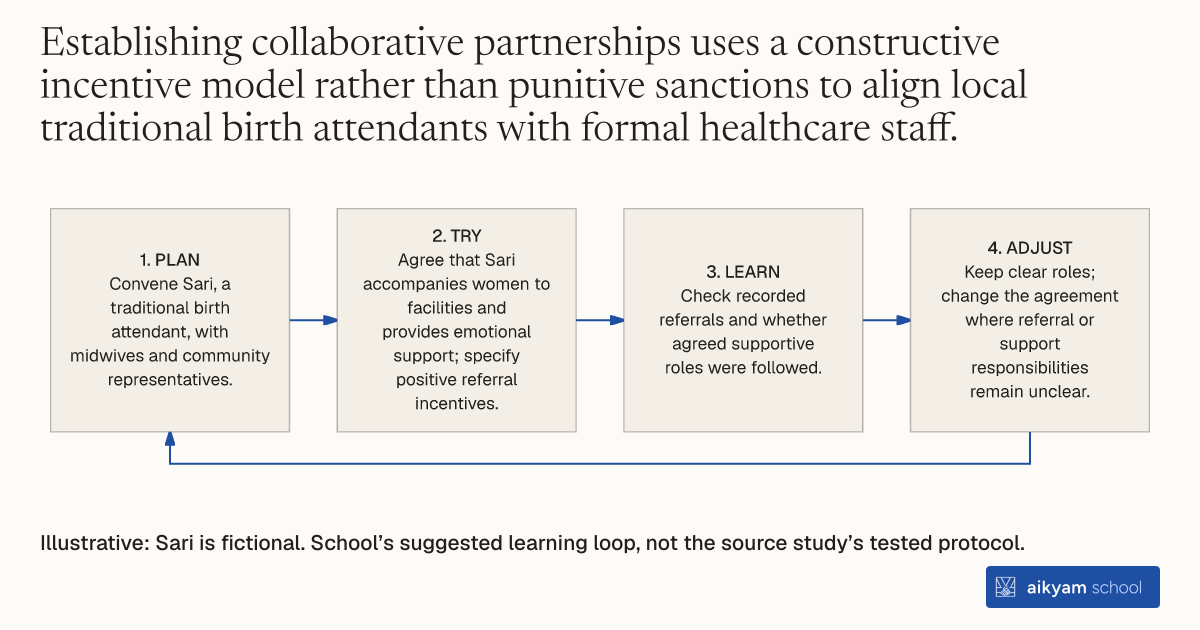
- Plan: Convene Sari, a traditional birth attendant, with midwives and community representatives.
- Try: Agree that Sari accompanies women to facilities and provides emotional support; specify positive referral incentives.
- Learn: Check recorded referrals and whether agreed supportive roles were followed.
- Adjust: Keep clear roles; change the agreement where referral or support responsibilities remain unclear.
Illustrative: Sari is fictional. School’s suggested learning loop, not the source study’s tested protocol.
See source →Observe partnership agreements and facility referrals; the programme’s action counts do not establish birth outcomes. School suggests this learning loop; it was not tested by the source.
How
When to use
Rural expectant mothers frequently rely on traditional birth attendants (TBAs) for home births, leading to high risks during childbirth complications. Health facility midwives and local organizers need a collaborative strategy to redirect pregnant women toward skilled health care. Program participants establish formal partnerships between certified midwives and TBAs to encourage facility deliveries.
Establish formal partnership agreements between health facility midwives and traditional birth attendants to ensure facility-based deliveries with skilled attendants.
- Convene community representatives, local midwives, and traditional birth attendants in a joint village meeting space.
- Discuss the maternal health risks of unsupervised home deliveries and review facility delivery advantages.
- Formulate a collaborative agreement where traditional birth attendants accompany laboring women to health facilities instead of conducting home deliveries.
- Assign clear supportive roles to traditional birth attendants during facility births, including offering emotional encouragement to mothers.
- Provide positive social incentives or small community rewards to traditional birth attendants for each successful health facility referral.
Why it works
Encouraging midwives and traditional birth attendants to work in tandem leverages existing community trust to guide expectant mothers toward facility-based skilled care.
Example
In rural Indonesian intervention villages, community representatives prioritized positive collaboration over punitive rules, making midwife and traditional birth attendant partnerships the most frequent health uptake action in Indonesia, representing 61.9% of pathway goals across 10.0% of Indonesian villages.
About the study
Participants
200 rural treatment villages across two regions in Indonesia and two regions in Tanzania, involving 100 intervention communities in each country.
Study Design
Randomized controlled trial evaluating a non-prescriptive social accountability initiative, collecting social action plans over a 90-day period and classifying community goals across intermediate outcome pathways.
Results
Midwife and traditional birth attendant partnerships represented 15.6% of health uptake pathway goals overall (61.9% in Indonesia and 1.4% in Tanzania), with communities in Indonesia adopting positive incentive partnerships over legal penalties.