Try, learn and adjust
Check radio vignettes and broadcast timing
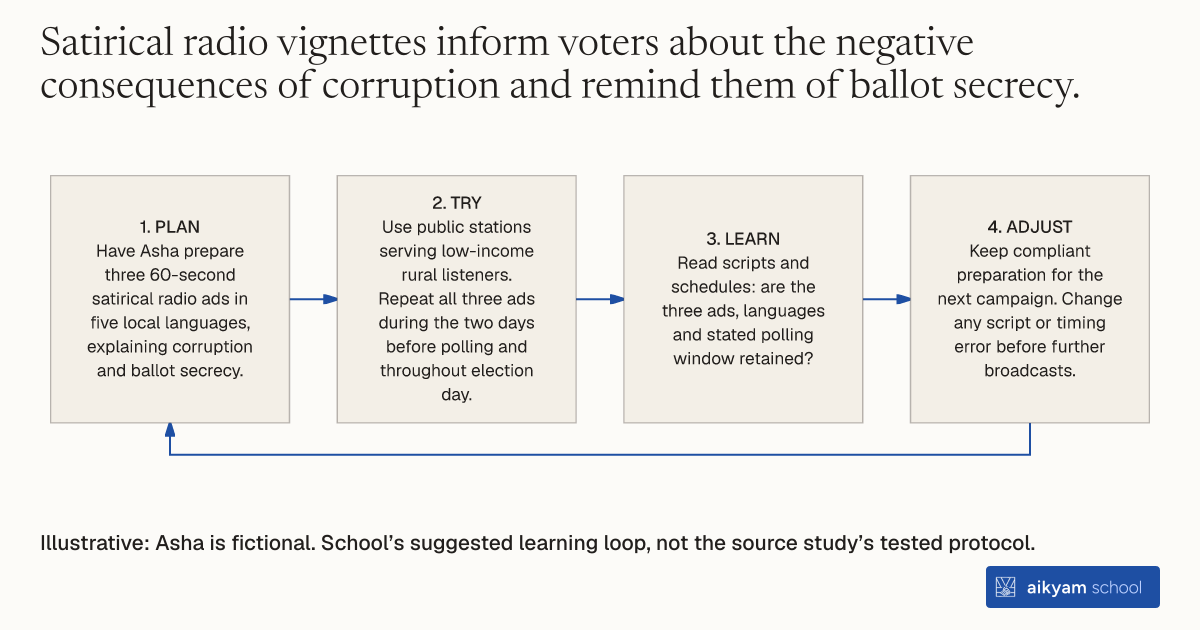
- Plan: Have Asha prepare three 60-second satirical radio ads in five local languages, explaining corruption and ballot secrecy.
- Try: Use public stations serving low-income rural listeners. Repeat all three ads during the two days before polling and throughout election day.
- Learn: Read scripts and schedules: are the three ads, languages and stated polling window retained?
- Adjust: Keep compliant preparation for the next campaign. Change any script or timing error before further broadcasts.
Illustrative: Asha is fictional. School’s suggested learning loop, not the source study’s tested protocol.
See source →School’s suggested, untested loop: observe ad content, language and schedule; do not treat the check as evidence of electoral impact.
How
When to use
Vote-buying remains widespread during elections in low- and middle-income countries. Bribes undermine candidate accountability and suppress the political voice of low-income voters. Broadcasters use non-partisan radio campaigns to inform vulnerable voters about the hidden social costs of corrupt gifts.
Broadcast satirical anti-vote-buying radio ads during election periods to reduce electoral support for corrupt parties.
- Media producers create three 60-second radio advertisements in five local languages.
- Scriptwriters frame each ad as a satirical vignette exposing the contrast between election promises and corrupt future behavior.
- Campaign organizers partner with public radio stations serving rural voters in low-income areas.
- Station operators air all three advertisements repeatedly during the two days before polling and throughout election day.
Why it works
Exposing corrupt incentives encourages citizens to switch their support to honest candidates without altering overall voter turnout.
Example
During the 2014 Indian general election, researchers aired three 60-second satirical vignettes in five regional languages across 30 treatment radio stations, reducing the vote share of vote-buying parties by 3.5 to 7.1 percentage points at a cost of US\$750 per station.
About the study
Participants
60 radio stations across 10 states in India, covering 67 percent of the national population and 62 percent of parliamentary constituencies.
Study Design
Randomized controlled trial dividing 60 rural All India Radio stations into a campaign treatment group and an unexposed comparison group.
Results
The campaign reduced the vote share of vote-buying parties by 3.5 to 7.1 percentage points and induced a persuasion rate of 10.3 to 20.8 percent toward non-vote-buying parties, with 78 voters persuaded per US\$1 spent.