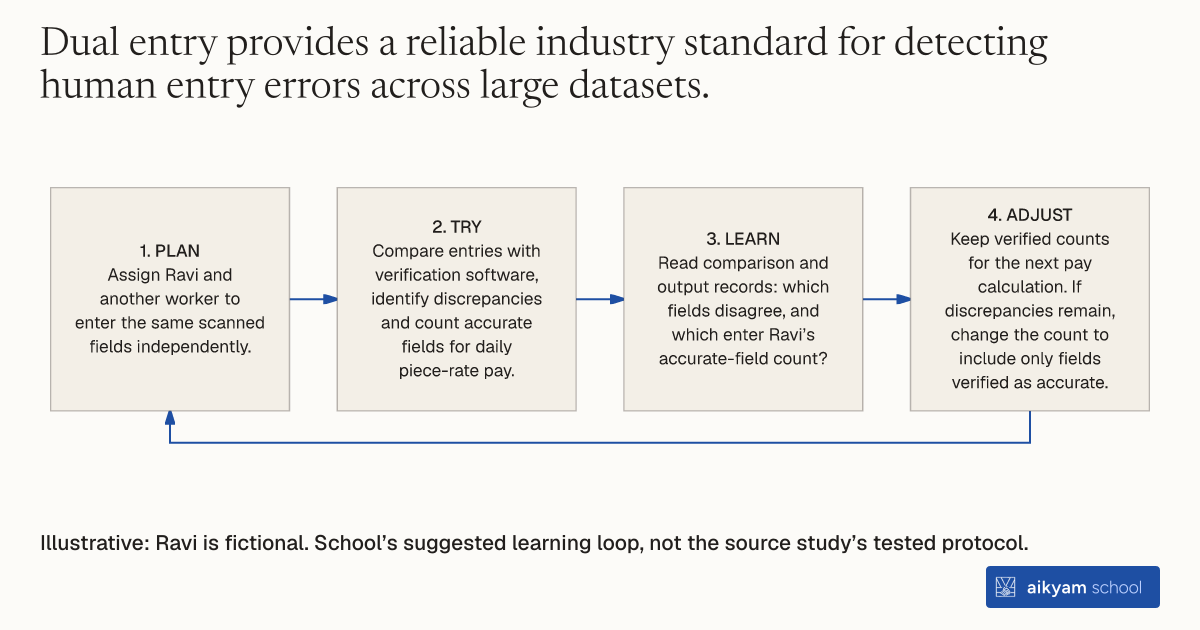
Try, learn and adjust
Check piece-rate pay counts only accurate fields
- Plan: Assign Ravi and another worker to enter the same scanned fields independently.
- Try: Compare entries with verification software, identify discrepancies and count accurate fields for daily piece-rate pay.
- Learn: Read comparison and output records: which fields disagree, and which enter Ravi’s accurate-field count?
- Adjust: Keep verified counts for the next pay calculation. If discrepancies remain, change the count to include only fields verified as accurate.
Illustrative: Ravi is fictional. School’s suggested learning loop, not the source study’s tested protocol.
See source →School’s suggested learning loop, not a source-tested procedure. Observe independent entries, discrepancies and accurate-field pay counts; matching volume alone does not establish accuracy.
How
When to use
A data entry company needs to verify the accuracy of digitized records entered by piece-rate workers. Paying purely for volume creates a risk that workers submit inaccurate entries to increase their earnings. This method provides an objective way to calculate error rates and pay only for accurate data fields.
Verify data entry accuracy by requiring two independent workers to enter the same data from scanned images.
- Have two separate workers independently type information from scanned images into computer screen fields.
- Compare the entries submitted by both workers for each field using automated verification software.
- Identify discrepancies between the two entries to pinpoint inaccuracies.
- Count the total number of accurate fields each worker completed each day.
- Pay workers their piece-rate earnings based strictly on the count of accurate fields entered.
Why it works
Basing piece-rate compensation on accurate entries ensures workers maintain quality while striving for higher volume.
Example
A data entry firm in Mysore, India used dual entry data verification to track daily output for 102 workers entering scanned image data. Workers entered roughly 5,300 fields per day on average and received Rs. 0.03 for each accurately entered field.
About the study
Participants
102 data entry workers in Mysore, India.
Study Design
Randomized controlled trial measuring worker output using dual-entry data verification as the standard quality control mechanism to determine piece-rate compensation.
Results
On an average day, workers entered roughly 5,300 fields accurately under piece-rate incentives based on dual-entry verification.