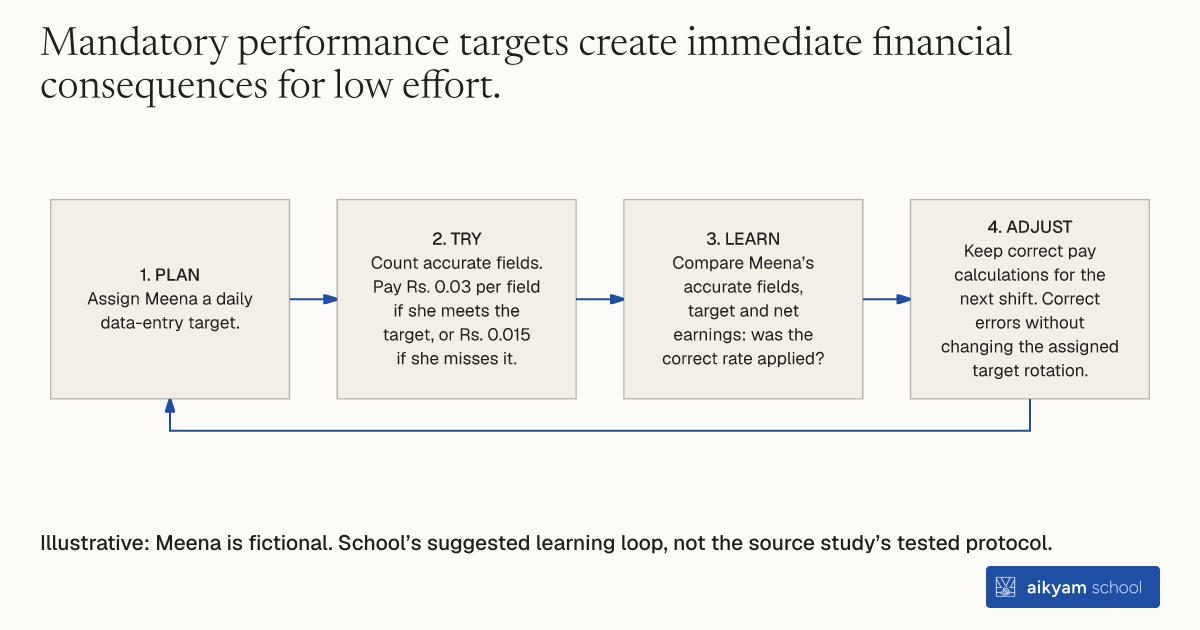
Try, learn and adjust
Check targets, output and wage penalties
- Plan: Assign Meena a daily data-entry target.
- Try: Count accurate fields. Pay Rs. 0.03 per field if she meets the target, or Rs. 0.015 if she misses it.
- Learn: Compare Meena’s accurate fields, target and net earnings: was the correct rate applied?
- Adjust: Keep correct pay calculations for the next shift. Correct errors without changing the assigned target rotation.
Illustrative: Meena is fictional. School’s suggested learning loop, not the source study’s tested protocol.
See source →School’s suggested, untested loop. Observe output, missed targets and net earnings. Higher output need not mean higher earnings.
How
When to use
A firm needs to prevent workplace slacking and boost employee output. Self-control problems and procrastination lead workers to fall short of productivity goals under standard piece-rate pay. Mandatory management targets with wage penalties force workers to maintain minimum daily output levels.
Impose binding daily production targets with pay penalties for employees who fail to meet output quotas.
- Establish specific daily data entry target levels for workers.
- Track the total number of accurate data fields completed by each worker during the shift.
- Pay workers the full standard piece rate of Rs. 0.03 per field when they reach or exceed the target.
- Reduce the piece rate by half to Rs. 0.015 per field if a worker fails to meet the assigned target level.
- Rotate target assignments among workers every eight or twelve days.
Why it works
The threat of losing half of piece-rate earnings deters procrastination and drives higher daily work output.
Example
A data entry firm in Mysore, India imposed target quotas on 102 workers for eight- to twelve-day rotation periods. While imposed targets increased overall output, workers missed their assigned targets between 8.6 and 14.1 percent of the time, preventing net earnings gains due to penalty deductions.
About the study
Participants
102 data entry workers in Mysore, India.
Study Design
Randomized controlled trial measuring worker output and earnings when management randomly assigned one of three mandatory target levels with a 50 percent piece-rate penalty for missing the target.
Results
Employer-defined targets increased overall worker production relative to baseline, but workers missed the assigned targets between 8.6 and 14.1 percent of the time, resulting in no overall increase in net earnings.