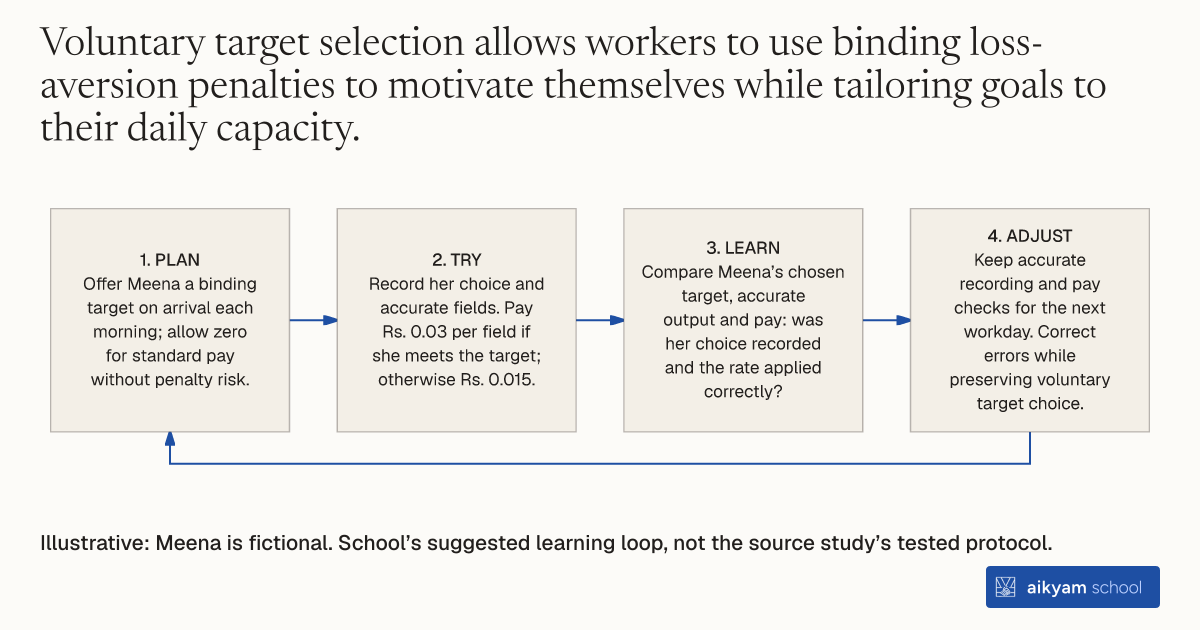
Try, learn and adjust
Check voluntary targets and pay
- Plan: Offer Meena a binding target on arrival each morning; allow zero for standard pay without penalty risk.
- Try: Record her choice and accurate fields. Pay Rs. 0.03 per field if she meets the target; otherwise Rs. 0.015.
- Learn: Compare Meena’s chosen target, accurate output and pay: was her choice recorded and the rate applied correctly?
- Adjust: Keep accurate recording and pay checks for the next workday. Correct errors while preserving voluntary target choice.
Illustrative: Meena is fictional. School’s suggested learning loop, not the source study’s tested protocol.
See source →School’s suggested, untested loop. Observe chosen targets, output and net earnings; do not assume Meena achieves the study average.
How
When to use
A firm wants to help employees overcome workplace procrastination and self-control problems without imposing mandatory quotas. Workers know they struggle with discipline but may hesitate to accept inflexible firm-level mandates. Offering optional daily morning targets allows workers to voluntarily commit to a specific output level before beginning work.
Offer employees the daily option to select a binding minimum production target upon arriving at work.
- Present employees with the choice to set a daily data entry target upon arrival at the workplace each morning.
- Allow workers to choose a target of zero if they prefer standard piece-rate pay without penalty risk.
- Record the voluntary daily output target chosen by each participating worker.
- Track total accurate data fields completed by the worker during the shift.
- Pay the standard piece rate of Rs. 0.03 per accurate field if the worker reaches or exceeds the self-set target.
- Reduce the piece rate to Rs. 0.015 per field if the worker fails to reach the self-set target.
Why it works
Choosing targets at the start of the workday commits present-biased workers to effort before daily distractions cause slacking.
Example
A data entry firm in Mysore, India gave 102 workers the morning option to set daily binding output targets. Workers selected positive targets roughly 28 percent of the time, missed their self-set targets only 2.6 percent of the time, and increased daily output by 120 fields compared to baseline.
About the study
Participants
102 data entry employees in Mysore, India.
Study Design
Randomized controlled trial offering workers rotating 8- to 12-day contract treatments, including the choice each morning to set a binding target with a 50 percent piece-rate penalty for missing it.
Results
Workers selected positive targets approximately 28 percent of the time, missed self-selected targets only 2.6 percent of the time, and increased total output by 120 fields (2 percent) relative to the baseline.