Research design
Randomise who receives the stove offer
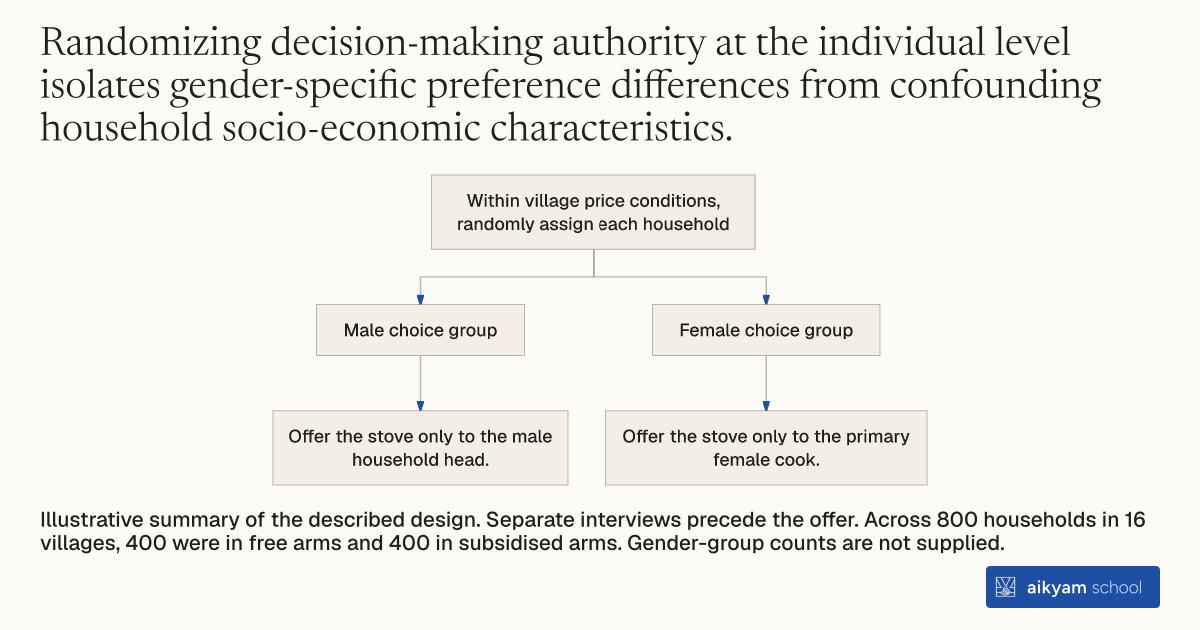
Within village price conditions, randomly assign each household
- Male choice group
- Offer the stove only to the male household head.
- Female choice group
- Offer the stove only to the primary female cook.
Illustrative summary of the described design. Separate interviews precede the offer. Across 800 households in 16 villages, 400 were in free arms and 400 in subsidised arms. Gender-group counts are not supplied.
See source →How
When to use
Development programs often assume that targeting women will yield higher technology adoption rates than targeting men. However, intra-household decision-making dynamics may align across gender lines when budget constraints and stove features are held equal. This method provides an individual-level experimental design to evaluate whether assigning purchase choices to male heads versus female cooks creates systematic differences in technology uptake.
Evaluate intra-household gender differences in technology demand by randomizing marketing offer choices at the individual household level to either the male household head or the primary female cook.
- Assign study villages to free or heavily subsidized price conditions to control for village-level price spillovers.
- Select target households within each village and randomly assign each household to either a male choice group or a female choice group.
- Deploy enumerator teams consisting of one male and one female interviewer to visit selected households.
- Separate the male household head and female primary cook to conduct independent questionnaire interviews.
- Present the cookstove offer exclusively to the randomly designated spouse (male head or primary female cook) to record their stove selection decision.
Why it works
Conducting separate interviews prevents spousal interference during preference elicitation and purchase choices.
Example
Researchers in 16 villages across Jamalpur Sadar and Hatia in Bangladesh randomly assigned 800 households to either the husband or wife to choose a free or subsidized cookstove.
About the study
Participants
800 households (400 in free arms E-F and 400 in subsidized arms G-H) across 16 villages in Jamalpur Sadar and Hatia upazilas, Bangladesh.
Study Design
Individual-level randomized controlled trial assigning cookstove choices and price offers (free vs heavily subsidized: Tk. 50 portable, Tk. 250 chimney) specifically to either the male household head or the wife/primary cook.
Results
Both men and women demonstrated an identical 36 percentage increase in actual adoption when stoves were offered for free or subsidized, with no statistically significant mean differences in stove choices or adoption decisions between genders.