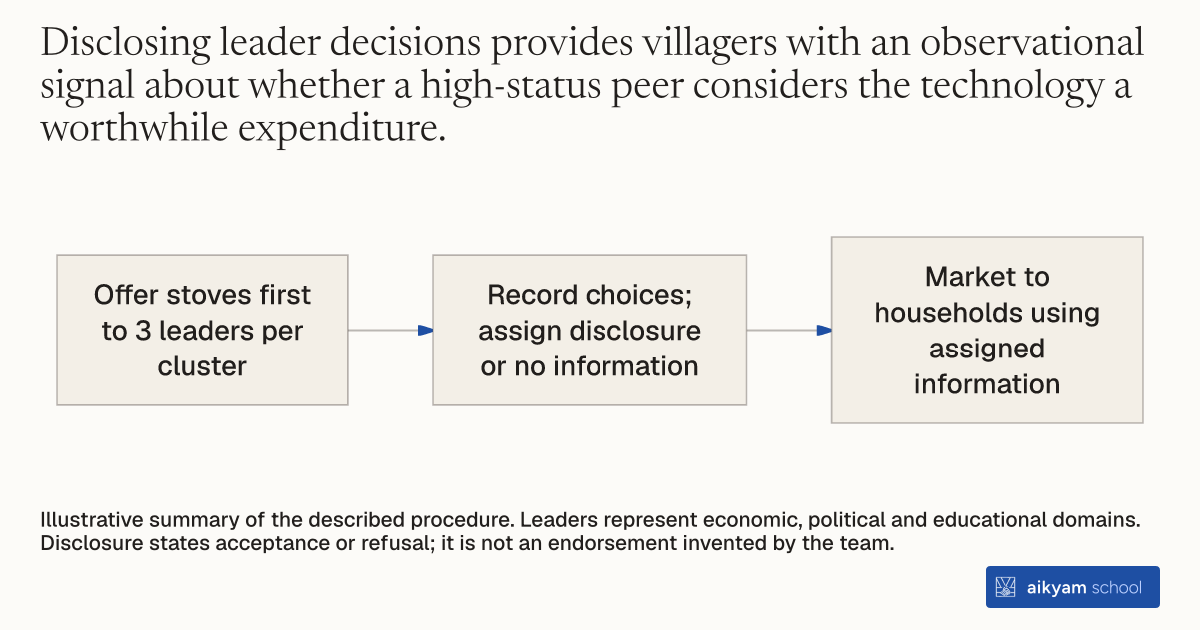
Research procedure
Disclose local leaders’ stove choices
- Offer stoves first to 3 leaders per cluster
- Record choices; assign disclosure or no information
- Market to households using assigned information
Illustrative summary of the described procedure. Leaders represent economic, political and educational domains. Disclosure states acceptance or refusal; it is not an endorsement invented by the team.
See source →How
When to use
Researchers need to evaluate how social network signals influence community adoption of novel technologies. Informing villagers about local leaders' purchase decisions can either encourage or deter household uptake. This method tests information diffusion by explicitly disclosing whether identified local leaders accepted or rejected the technology offer.
Test social network influence by disclosing whether local village opinion leaders accepted or rejected a technology offer to neighboring household clusters.
- Identify 3 opinion leaders in each neighborhood cluster across economic, political, and educational domains.
- Visit opinion leader households first to present the cookstove marketing offer at full or subsidized prices.
- Record whether each of the 3 leaders accepted or rejected the stove offer.
- Assign neighborhood clusters within study villages to receive information disclosure about their leaders' decisions or no information.
- Deploy enumerators to market the cookstove to general households in treatment clusters, explicitly stating whether their local leaders accepted or refused the offer.
Why it works
While leader acceptance signals potential utility, unanimous leader refusal serves as a strong risk-avoidance signal for poorer households.
Example
Researchers across 21 villages in Jamalpur Sadar and Hatia, Bangladesh disclosed opinion leader adoption choices to 500 households across 10 villages in full-price and subsidized arms.
About the study
Participants
500 households across 10 villages (21 para clusters) in Jamalpur Sadar and Hatia upazilas, Bangladesh.
Study Design
Cluster-randomized information disclosure experiment informing general households whether their 3 local para opinion leaders accepted or rejected the cookstove offer at assigned price points.
Results
Knowing that all three opinion leaders accepted a cookstove had no statistically significant effect on villager adoption, but unanimous rejection by opinion leaders led to zero adoption (0%) of portable and chimney cookstoves.