Research procedure
Sample cooking practices across regions
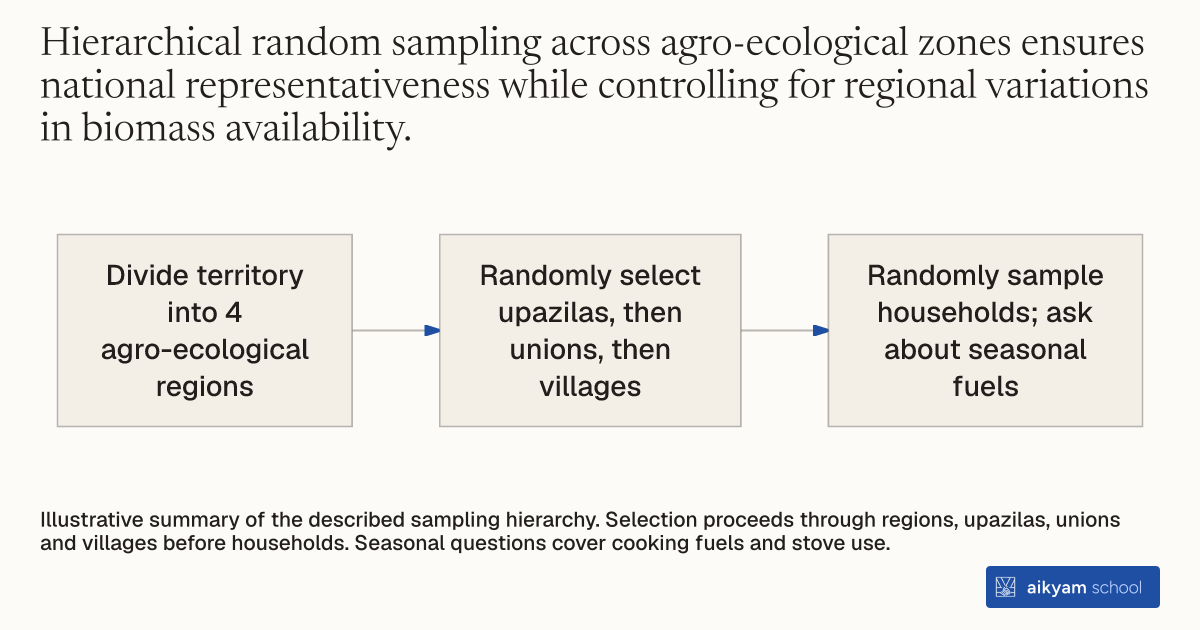
- Divide territory into 4 agro-ecological regions
- Randomly select upazilas, then unions, then villages
- Randomly sample households; ask about seasonal fuels
Illustrative summary of the described sampling hierarchy. Selection proceeds through regions, upazilas, unions and villages before households. Seasonal questions cover cooking fuels and stove use.
See source →How
When to use
Researchers need to establish baseline cooking practices, biomass fuel dependencies, and existing stove penetration across diverse geographical zones before designing a national intervention trial. Attempting a trial without national diagnostic data can lead to targeting inappropriate fuel types or miscalculating baseline adoption rates. This method provides a nationwide stratified sampling protocol to assess seasonal cooking behaviors across rural populations.
Divide a country into four agro-ecological regions and select households through a four-stage random sampling hierarchy.
- Divide the nationwide territory into 4 regions based on distinct agro-ecological characteristics.
- Randomly select 30 upazilas from across the 4 agro-ecological regions.
- Randomly select 30 unions by drawing 1 union from each selected upazila.
- Randomly select 30 villages by drawing 1 village from each selected union.
- Survey 20 randomly selected households in each village to collect seasonal fuel use and stove usage data across 2,400 total households.
Why it works
Collecting seasonal data reveals critical operational constraints, such as dry-season reliance on loose agricultural residues.
Example
Researchers in Bangladesh sampled 2,400 rural households across 4 agro-ecological regions in 2006, discovering that traditional stoves were used by 99 percent of households while improved cookstove adoption remained below 1 percent.
About the study
Participants
2,400 rural households across 30 villages, 30 unions, and 30 upazilas in 4 agro-ecological regions of Bangladesh.
Study Design
Four-stage nationally representative random survey sampling (4 regions x 30 villages x 20 households per village) assessing dry and rainy season fuel types, costs, and cookstove models.
Results
Traditional cookstoves were used by 99 percent of rural households (67 percent using multiple traditional stoves in the dry season), while improved cookstove penetration was less than 1 percent (0.8 percent in dry season, 0.5 percent in rainy season), with 80 percent relying on agricultural residues as primary or secondary fuel.