Try, learn and adjust
Check baseline counselling and condom distribution
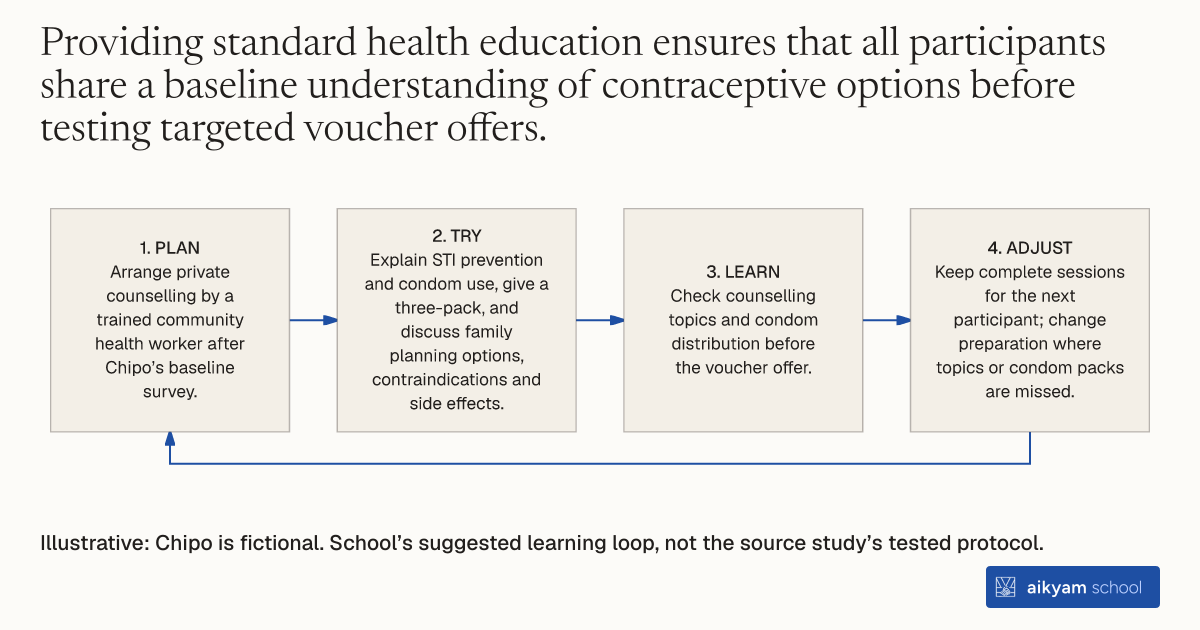
- Plan: Arrange private counselling by a trained community health worker after Chipo’s baseline survey.
- Try: Explain STI prevention and condom use, give a three-pack, and discuss family planning options, contraindications and side effects.
- Learn: Check counselling topics and condom distribution before the voucher offer.
- Adjust: Keep complete sessions for the next participant; change preparation where topics or condom packs are missed.
Illustrative: Chipo is fictional. School’s suggested learning loop, not the source study’s tested protocol.
See source →School’s suggested learning loop; not a tested source procedure. Observe topic coverage and distribution. School’s loop is a learning aid, not a clinical counselling protocol or evidence of health effects.
How
When to use
Field teams need to provide baseline health education before introducing specific family planning options. Women living in low-income urban areas often lack clear information about sexually transmitted disease prevention and modern birth control methods. Delivering health counseling alongside free condom samples gives respondents basic reproductive knowledge and protection.
Deliver a structured health education session and condom package to married women during home visits.
- Assign a trained community health worker from the local clinic to lead the education session privately at the end of the baseline survey visit.
- Present oral information on preventing sexually transmitted diseases and demonstrate correct condom use.
- Hand out a three-pack of condoms directly to the participant.
- Explain the health benefits of family planning and review the range of birth control options available at the local clinic.
- Provide detailed counseling on injectable contraceptives and implants, including medical contraindications, side effects, and dual protection strategies.
Why it works
Coupling family planning advice with disease prevention encourages women to consider dual-protection strategies.
Example
Community health workers in Lusaka, Zambia delivered health counseling and three-packs of condoms to 749 married women aged 18 to 40 following their baseline survey at Chipata Clinic. All participants received identical health information about STI prevention, pills, injectables, and implants before receiving randomized clinic vouchers.
About the study
Participants
749 married women aged 18 to 40 in Lusaka, Zambia.
Study Design
Standardized health information and condom distribution session delivered by community health workers prior to voucher randomization.
Results
Health counseling established universal baseline awareness of injectables, pills, and condoms across both trial arms, with 88.9 percent of Individual participants and 87.3 percent of Couple participants reporting prior modern contraceptive experience.