Try, learn and adjust
Check voucher holders can use fast-track appointments
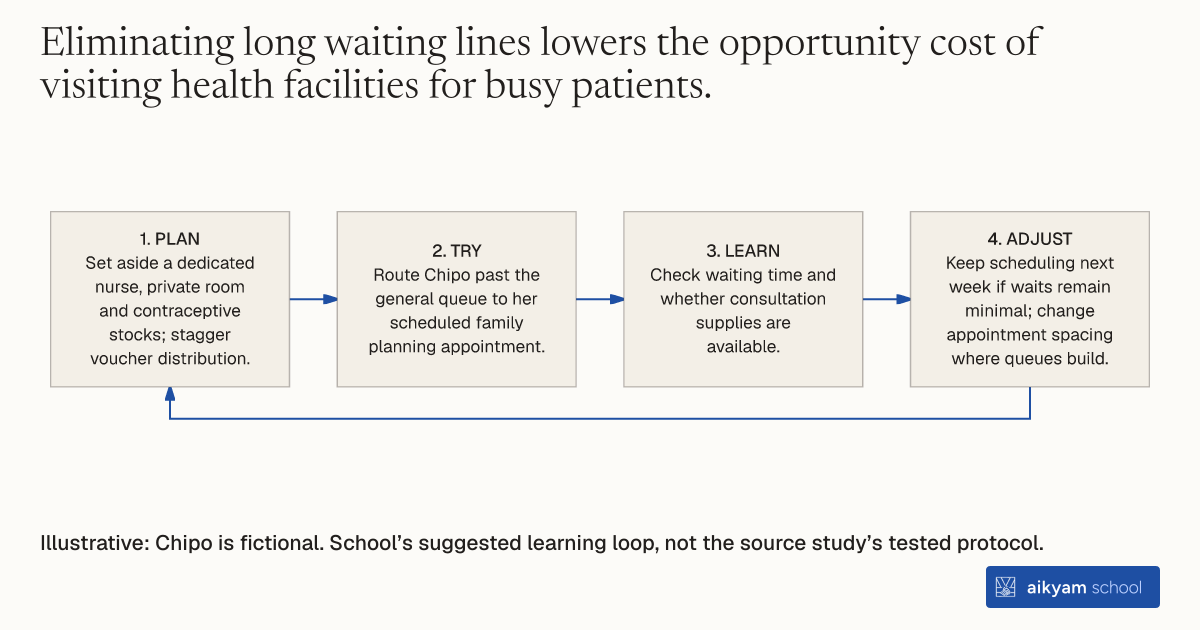
- Plan: Set aside a dedicated nurse, private room and contraceptive stocks; stagger voucher distribution.
- Try: Route Chipo past the general queue to her scheduled family planning appointment.
- Learn: Check waiting time and whether consultation supplies are available.
- Adjust: Keep scheduling next week if waits remain minimal; change appointment spacing where queues build.
Illustrative: Chipo is fictional. School’s suggested learning loop, not the source study’s tested protocol.
See source →School’s suggested learning loop; not a tested source procedure. Observe appointment access, delays and stock availability. This is a service check, not a clinical protocol.
How
When to use
Women seeking family planning services in public health facilities often face waiting times of three to four hours and frequent drug stockouts. High opportunity costs and long queues discourage patients from obtaining regular contraceptive refills. Establishing dedicated appointment slots with minimal wait times enables women to access reproductive health consultations efficiently.
Set up a fast-track scheduling system with a dedicated nurse to streamline family planning clinic visits.
- Assign a dedicated family planning nurse and private room inside the local health facility.
- Space voucher distribution across several months to limit weekly patient volume and prevent queue bottlenecks.
- Establish direct bypass routing so voucher holders skip the general outpatient queue upon arrival at Chipata Clinic.
- Issue scheduled appointments that guarantee minimal waiting times for reproductive health consultations.
- Maintain dedicated clinic stocks of injectable contraceptives and oral pills to ensure immediate dispensing during visits.
Why it works
Dedicated staffing ensures reliable access to contraceptive supplies that are otherwise frequently out of stock.
Example
Chipata Clinic in Lusaka, Zambia set up a dedicated family planning room and nurse to serve 749 study participants holding access vouchers. The fast-track system allowed voucher holders to bypass general queues that typically took two to four hours, resulting in a 48 percent overall voucher redemption rate.
About the study
Participants
749 married women aged 18 to 40 in Lusaka, Zambia.
Study Design
Fast-track appointment system with dedicated clinic staffing implemented alongside a randomized controlled voucher trial.
Results
Fast-track appointments reduced average clinic waiting times from two to four hours down to minimal delays, achieving a 48 percent voucher redemption rate across the 749 enrolled women.