Research procedure
Describe the joint voucher study arm
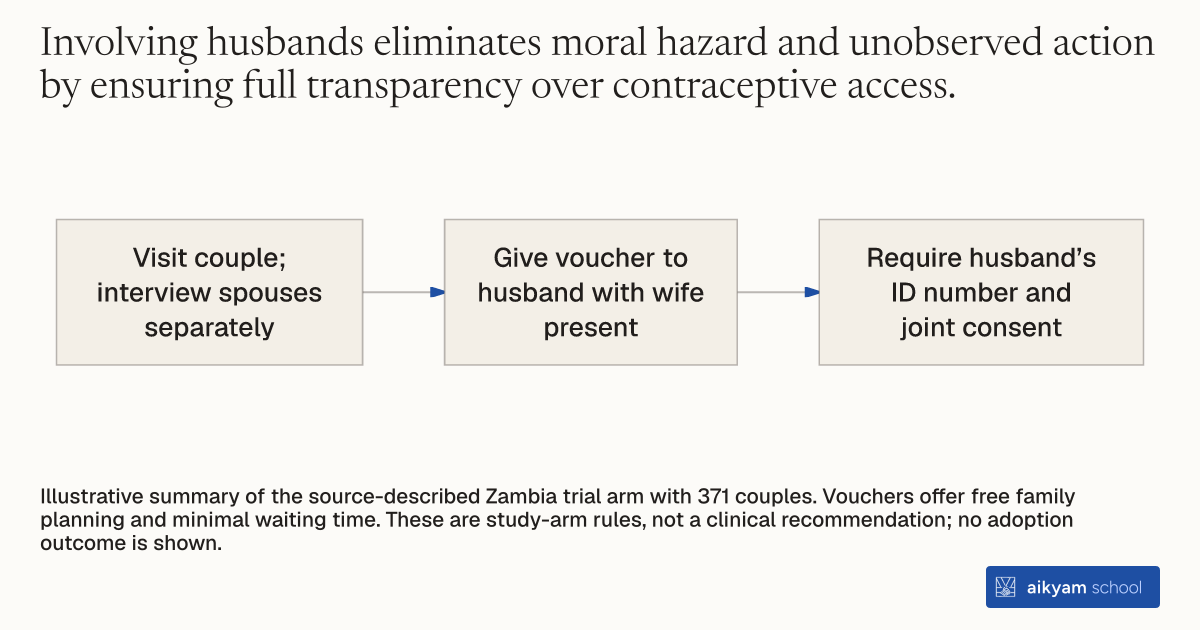
- Visit couple; interview spouses separately
- Give voucher to husband with wife present
- Require husband’s ID number and joint consent
Illustrative summary of the source-described Zambia trial arm with 371 couples. Vouchers offer free family planning and minimal waiting time. These are study-arm rules, not a clinical recommendation; no adoption outcome is shown.
See source →How
When to use
Family planning programs often seek to involve husbands in reproductive healthcare decisions to encourage joint household agreement. However, requiring spousal participation can give men direct veto power over birth control choices when partners disagree on family size. Handing family planning vouchers jointly to couples tests how male oversight affects contraceptive adoption among married women.
Distribute family planning vouchers jointly to married couples during household visits with both spouses present.
- Schedule a joint household visit with the enrolled woman and her husband.
- Interview the husband privately regarding his income and fertility preferences, then survey the wife separately.
- Present a health voucher directly to the husband in the presence of his wife that offers free, immediate access to family planning services at the local clinic.
- Record the husband's National Registration Card number on the voucher to enforce joint authorization.
- Explain that the voucher guarantees minimal waiting time and access to injectables or implants at the clinic, provided both spouses consent to its use.
Why it works
Giving husbands decision rights aligns clinic visits with shared spousal consent rules while preventing secret birth control use.
Example
Field teams in Lusaka, Zambia presented family planning vouchers jointly to 371 married couples living near Chipata Clinic. Handing vouchers directly to husbands lowered clinic redemption to 42.8 percent and reduced injectable contraceptive uptake to 18.3 percent.
About the study
Participants
371 married couples with wives aged 18 to 40 in Lusaka, Zambia.
Study Design
Randomized controlled trial arm where vouchers for free family planning access were handed to husbands in the presence of their wives, requiring the husband's national identity number.
Results
Joint voucher provision resulted in a 42.8 percent redemption rate compared to 52.9 percent in the private individual condition (a 19 percent reduction). Injectable uptake fell by 6.0 percentage points (from 24.3 percent to 18.3 percent, a 25 percent decrease). Among couples with misaligned fertility preferences, joint vouchers reduced injectable adoption by 13.6 percentage points (from 28.4 percent to 14.8 percent).