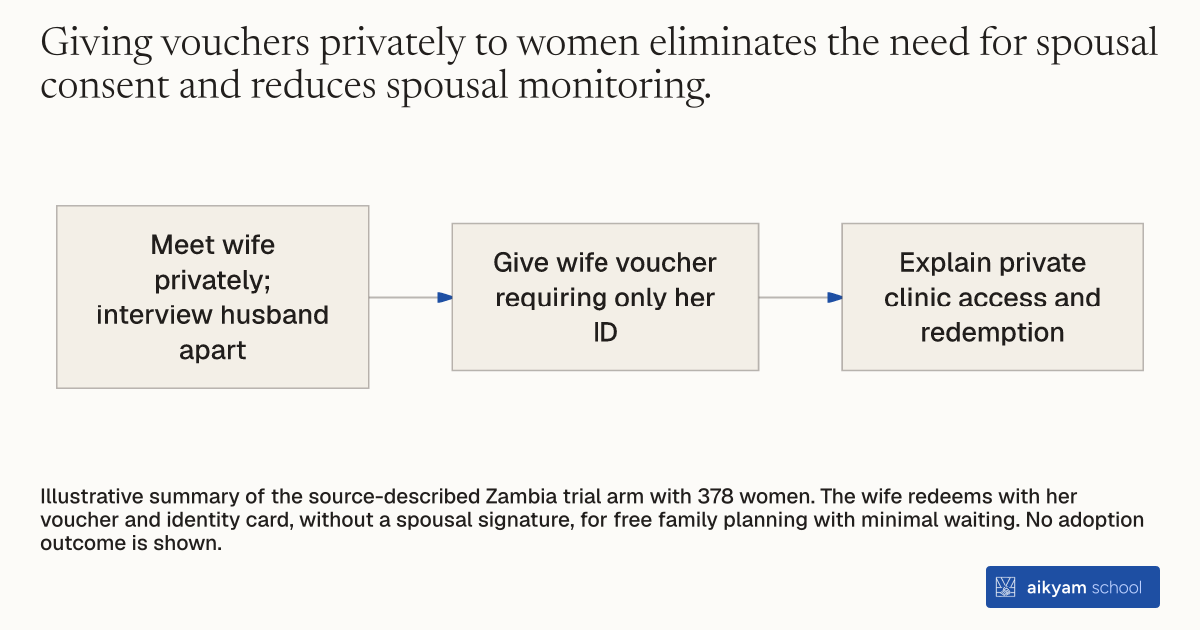
Research procedure
Describe the private voucher study arm
- Meet wife privately; interview husband apart
- Give wife voucher requiring only her ID
- Explain private clinic access and redemption
Illustrative summary of the source-described Zambia trial arm with 378 women. The wife redeems with her voucher and identity card, without a spousal signature, for free family planning with minimal waiting. No adoption outcome is shown.
See source →How
When to use
Women living in low-income urban settings often face spousal opposition when seeking reproductive healthcare. Standard clinic delivery systems can expose women to spousal monitoring or veto power over family planning decisions. Distributing private vouchers directly to women allows individuals to access free health consultations and concealable birth control independently.
Distribute private family planning vouchers directly to married women during confidential home visits without spousal participation.
- Schedule a private follow-up visit with the enrolled woman in her home while her husband is interviewed separately.
- Provide a health voucher handed directly to the wife in private that guarantees free, immediate access to contraceptives and minimal clinic wait times.
- Record only the wife's National Registration Card number on the voucher to authorize single-signature redemption.
- Explain that the voucher guarantees private consultation with a family planning nurse and access to concealable methods like injectables and implants.
- Instruct the recipient to keep the voucher secure and present it along with her national identity card at the health clinic.
Why it works
This privacy enables women to overcome household bargaining barriers and adopt effective concealable birth control methods.
Example
Field teams in Lusaka, Zambia privately distributed family planning vouchers to 378 married women living near Chipata Clinic. Recipients used the vouchers to bypass long clinic lines and obtain free injectable contraceptives without requiring spousal signatures.
About the study
Participants
378 married women aged 18 to 40 in Lusaka, Zambia.
Study Design
Randomized controlled trial arm where vouchers guaranteeing free family planning access were handed privately to women alone, requiring only the wife's national registration number.
Results
Private voucher provision resulted in a 52.9 percent redemption rate at Chipata Clinic, compared to 42.8 percent in the joint couple condition. Among women receiving private vouchers, 24.3 percent adopted injectable contraceptives compared to 18.3 percent in the couple arm, representing a 25 percent increase in injectable adoption.