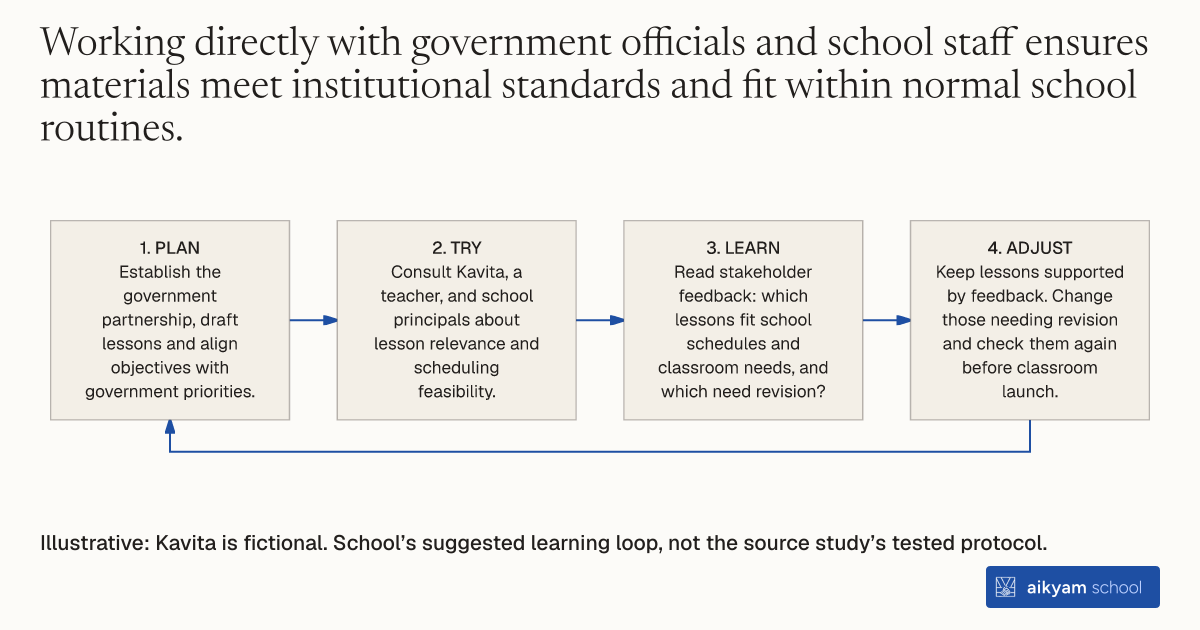
Try, learn and adjust
Check curriculum relevance and school feasibility before launch
- Plan: Establish the government partnership, draft lessons and align objectives with government priorities.
- Try: Consult Kavita, a teacher, and school principals about lesson relevance and scheduling feasibility.
- Learn: Read stakeholder feedback: which lessons fit school schedules and classroom needs, and which need revision?
- Adjust: Keep lessons supported by feedback. Change those needing revision and check them again before classroom launch.
Illustrative: Kavita is fictional. School’s suggested learning loop, not the source study’s tested protocol.
See source →School’s suggested, untested loop. Observe feedback from officials, principals and teachers on relevance and scheduling.
How
When to use
In public school systems, non-profit programs often fail to achieve scale if created without official input. This method addresses institutional resistance and curriculum misalignment by co-designing materials between civil society groups and government education authorities. It serves program developers, civil society leaders, and education officials seeking to embed social change topics into state schools.
Engage education officials, school principals, and teachers in a collaborative co-design process to ensure programs are feasible for public schools.
- Non-profit leaders establish an official partnership with government education authorities to target social inequality.
- Non-profit curriculum experts develop initial discussion topics and lesson materials.
- Program staff engage closely with state education officials to align lesson objectives with government priorities.
- Program staff consult school principals and classroom teachers to evaluate scheduling feasibility and classroom relevance.
- Program teams refine lesson plans based on stakeholder feedback before launching classroom delivery.
Why it works
This engagement builds institutional buy-in and lays the groundwork for incorporating programs into government curricula.
Example
Breakthrough partnered with the Government of Haryana, engaging education officials, principals, and teachers to design the *Taaron ki Toli* curriculum for 150 public schools. The resulting 27-session program was successfully implemented over two and a half years, increasing students' gender attitude index by 0.25 standard deviations.
About the study
Participants
Nearly 15,000 students in grades 7–8 (aged 11–15) across 314 government schools in Haryana, India.
Study Design
School-level cluster randomized controlled trial comparing 150 treatment schools receiving the co-designed curriculum against 164 comparison schools.
Results
Gender attitude index increased by 0.25 standard deviations, gender behavior index increased by 0.32 standard deviations, and the collaborative process enabled full implementation across 150 public schools.