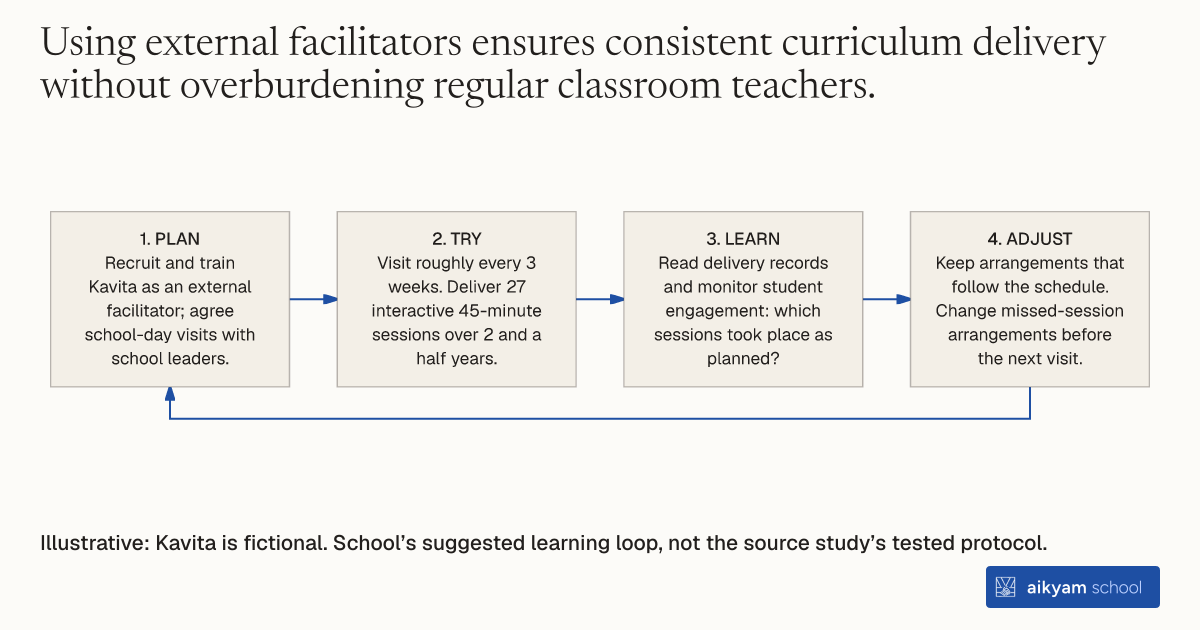
Try, learn and adjust
Check external facilitators follow the lesson schedule
- Plan: Recruit and train Kavita as an external facilitator; agree school-day visits with school leaders.
- Try: Visit roughly every 3 weeks. Deliver 27 interactive 45-minute sessions over 2 and a half years.
- Learn: Read delivery records and monitor student engagement: which sessions took place as planned?
- Adjust: Keep arrangements that follow the schedule. Change missed-session arrangements before the next visit.
Illustrative: Kavita is fictional. School’s suggested learning loop, not the source study’s tested protocol.
See source →School’s suggested learning loop: observe session delivery and engagement. School’s loop does not isolate the external facilitator’s effect from the wider programme.
How
When to use
School systems often lack specialized staff or training to address sensitive social norms like gender discrimination. This method provides an external delivery model where trained non-profit facilitators enter public schools to conduct specialized attitude-change sessions. It serves secondary school administrators and policy makers seeking standardized implementation of social change curricula.
Deploy specialized external facilitators to deliver a structured gender equality curriculum directly within government schools.
- Non-profit organizations recruit and train external facilitators to lead classroom discussions on sensitive social topics.
- Facilitators collaborate with school leadership to schedule regular classroom visits during the normal school day.
- Facilitators visit assigned public schools approximately every three weeks throughout the academic year.
- Facilitators lead twenty-seven 45-minute interactive discussion sessions across two and a half years.
- External staff maintain implementation fidelity across multiple schools while monitoring student engagement in classroom activities.
Why it works
External instructors bring specialized expertise and neutral perspectives that help students discuss entrenched social norms more openly.
Example
Fifteen external facilitators hired by Breakthrough delivered 27 interactive sessions across 150 government schools in Haryana, India, over two and a half years. The delivery model successfully increased students' gender attitude index by 0.25 standard deviations and gender-specific behavior index by 0.32 standard deviations.
About the study
Participants
Nearly 15,000 students in grades 7–8 (aged 11–15) across 314 government schools in Haryana, India.
Study Design
School-level cluster randomized controlled trial comparing 150 treatment schools visited by external facilitators with 164 comparison schools.
Results
Facilitator-led delivery increased the gender attitude index by 0.25 standard deviations and the gender-specific behavior index by 0.32 standard deviations (0.46 for boys, 0.21 for girls).