Try, learn and adjust
Check optional youth clubs support discussion
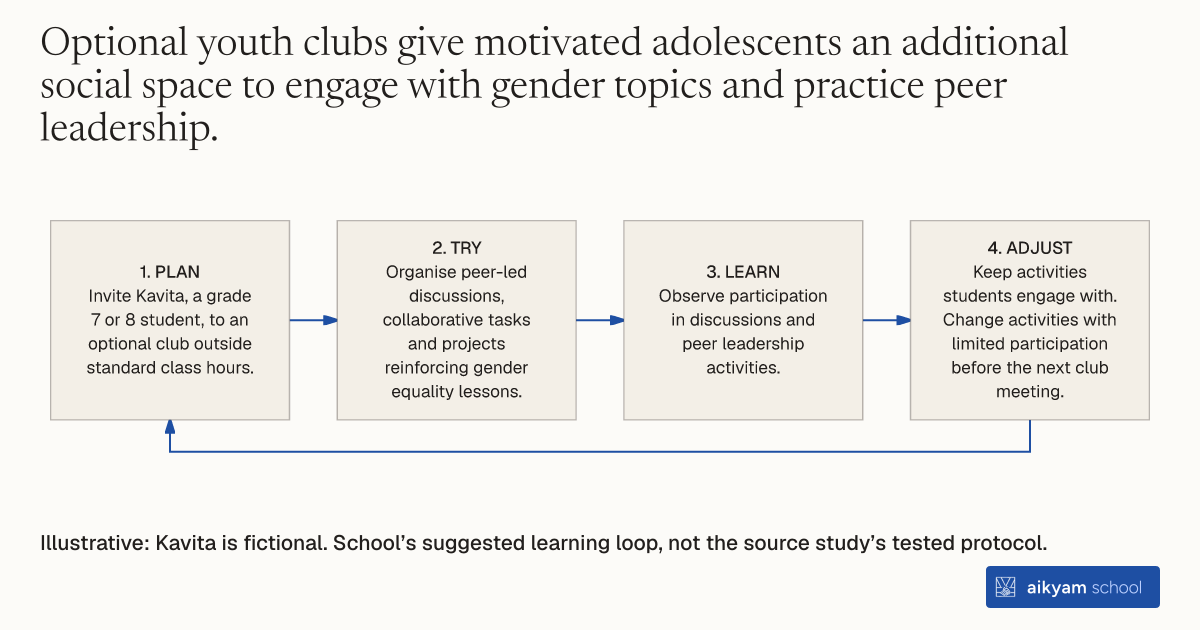
- Plan: Invite Kavita, a grade 7 or 8 student, to an optional club outside standard class hours.
- Try: Organise peer-led discussions, collaborative tasks and projects reinforcing gender equality lessons.
- Learn: Observe participation in discussions and peer leadership activities.
- Adjust: Keep activities students engage with. Change activities with limited participation before the next club meeting.
Illustrative: Kavita is fictional. School’s suggested learning loop, not the source study’s tested protocol.
See source →School’s suggested learning loop: observe club engagement. The evaluation covered clubs alongside classroom sessions; it does not establish the club’s separate effect.
How
When to use
In schools implementing gender equality programs, students may seek additional peer-led environments to explore leadership and gender topics outside regular class time. This method provides optional extracurricular school clubs to deepen student engagement with gender rights concepts. It targets secondary school students wanting further leadership and discussion opportunities beyond core classroom sessions.
Establish optional student-led youth clubs within participating schools to supplement regular classroom gender equality lessons.
- Program staff support participating schools in launching optional extracurricular clubs, such as Breakthrough's Taaron ki Toli youth clubs.
- School leadership invites interested students in grades 7 and 8 to join club activities outside of standard class hours.
- Club facilitators or student leaders organize supplementary group discussions and collaborative activities focused on gender equality.
- Participating students complete interactive tasks and peer-led projects reinforcing classroom lesson themes.
- Club members practice peer leadership and advocate equitable norms among their schoolmates.
Why it works
These extracurricular activities reinforce core classroom concepts and foster supportive peer networks around equitable gender norms.
Example
Breakthrough established optional youth clubs alongside 27 classroom sessions in 150 government schools in Haryana, India, contributing to a 0.25 standard deviation increase in students' gender attitude index and a 0.32 standard deviation increase in gender-equitable behavior.
About the study
Participants
Nearly 15,000 students in grades 7–8 (aged 11–15) across 314 government schools in Haryana, India.
Study Design
School-level cluster randomized controlled trial evaluating 150 treatment schools featuring optional youth clubs alongside classroom discussions against 164 comparison schools.
Results
Gender attitude index increased by 0.25 standard deviations, gender-specific behavior index increased by 0.32 standard deviations (0.46 for boys, 0.21 for girls), and female employment support increased by 12.9 percentage points.