Try, learn and adjust
Check an investigated service problem reaches radio listeners
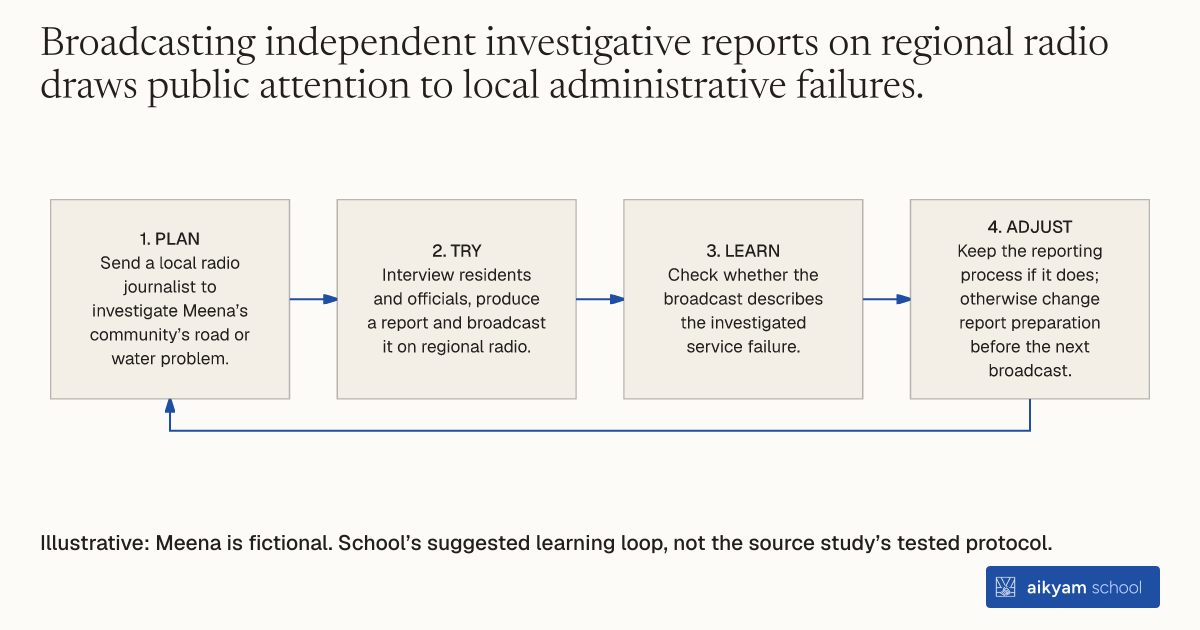
- Plan: Send a local radio journalist to investigate Meena’s community’s road or water problem.
- Try: Interview residents and officials, produce a report and broadcast it on regional radio.
- Learn: Check whether the broadcast describes the investigated service failure.
- Adjust: Keep the reporting process if it does; otherwise change report preparation before the next broadcast.
Illustrative: Meena is fictional. School’s suggested learning loop, not the source study’s tested protocol.
See source →On-site investigation, interviews and broadcast coverage; no assumed repair. School’s suggested learning loop, not a source-tested cycle.
How
When to use
Local government ministries neglect public infrastructure problems like broken roads and water points in rural communities. Citizens lack formal channels to demand public service improvements from unelected officials. Media organizations deploy local journalists to investigate service delivery failures and broadcast investigative reports to spur government responsiveness.
Deploy local radio journalists to investigate community service delivery problems and broadcast investigative news stories on regional stations.
- Identify rural communities experiencing persistent service delivery problems with local roads or water infrastructure.
- Dispatch journalists from local radio stations to conduct on-site investigations in target communities.
- Interview community residents and local officials to identify the underlying causes of service failures.
- Produce investigative news reports detailing the specific service delivery failures and administrative breakdowns.
- Broadcast the investigative reports across regional radio stations to inform the public and local authorities.
Why it works
Public coverage incentivizes government ministries to address service defects to maintain public credibility.
Example
In Tanzania, local radio journalists visited randomly selected communities to investigate service delivery issues like road and water defects and broadcast stories on regional radio, leading program communities to achieve higher service delivery scores from independent auditors.
About the study
Participants
Rural communities and local radio listeners across regions in Tanzania.
Study Design
Randomized field experiment evaluating local radio investigative journalism visits and broadcasts against unexposed control communities.
Results
Communities randomly selected for investigative radio visits received higher service delivery scores when evaluated by independent auditors.