Try, learn and adjust
Check fees stay within the vaccination cap
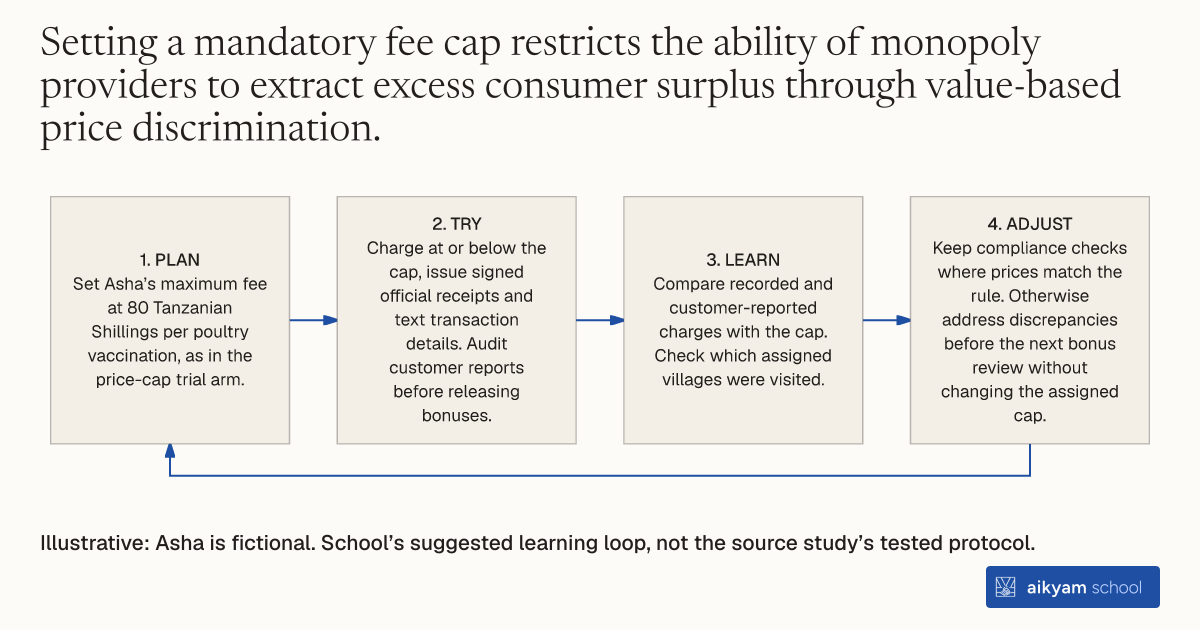
- Plan: Set Asha’s maximum fee at 80 Tanzanian Shillings per poultry vaccination, as in the price-cap trial arm.
- Try: Charge at or below the cap, issue signed official receipts and text transaction details. Audit customer reports before releasing bonuses.
- Learn: Compare recorded and customer-reported charges with the cap. Check which assigned villages were visited.
- Adjust: Keep compliance checks where prices match the rule. Otherwise address discrepancies before the next bonus review without changing the assigned cap.
Illustrative: Asha is fictional. School’s suggested learning loop, not the source study’s tested protocol.
See source →School’s suggested, untested loop: observe fee compliance and village coverage. The trial reduced visits to remote villages despite lower prices.
How
When to use
Monopolistic service providers charge elevated fees and extract economic surplus from vulnerable customers. Capping maximum allowed user charges limits financial exploitation and makes essential services affordable for households in need. This method applies when regulating local service agents who set prices independently.
Impose a strict ceiling on user fees charged by frontline service delivery agents while allowing discretion over target areas.
- Local government supervisors set a maximum allowable unit price for the service during orientation meetings before the campaign starts.
- Training staff distribute official serialized paper receipts stamped with the national emblem to every service agent.
- Service agents travel to local households and deliver services while charging fees at or below the official price cap.
- Service agents record customer phone numbers and issue signed government receipts for every transaction.
- Service agents transmit transaction data to a central ministry database using a mobile phone SMS reporting template.
- Central supervisors conduct random phone verification calls with customers to audit price compliance before releasing output bonus payments.
Why it works
Lowering unit prices directly increases service affordability and enables poorer households with low willingness to pay to access the service.
Example
The Ministry of Agriculture, Livestock and Fisheries in Tanzania assigned government veterinary extension agents across 276 administrative wards to charge no more than 80 Tanzanian Shillings per poultry vaccination. Agents issued national emblem receipts, reported sales by SMS, and delivered vaccinations across rural villages during a 3-week campaign. The price cap successfully reduced average unit prices by 17% and enabled 12% to 15% more previously unserved farmers to receive vaccinations.
About the study
Participants
832 frontline government veterinary extension agents and 3,580 verified smallholder farmers across 550 administrative wards in 27 districts of Tanzania (Dodoma, Iringa, Morogoro, and Tanga regions).
Study Design
Stratified randomized controlled trial allocating 276 wards to an 80 Tanzanian Shillings price-cap treatment and 274 wards to full pricing discretion, with compliance enforced via official receipts, SMS logging, and 15% random phone recipient audits.
Results
The price cap reduced average unit prices by 17% (from 76.28 to 63.46 Tanzanian Shillings, p < 0.01) and within-agent price variation by 42% (p < 0.01). Capping prices increased service extension to previously unserved farmers by 12% to 15% (p < 0.05) and agricultural households by 6% (p < 0.05), but reduced the proportion of assigned villages visited by 4.45 percentage points (from a control mean of 37%) and reduced visits to remote villages located above median distance by 25% (9.66 percentage points, p < 0.01).