Research steps
Elicit expected costs of a malaria episode
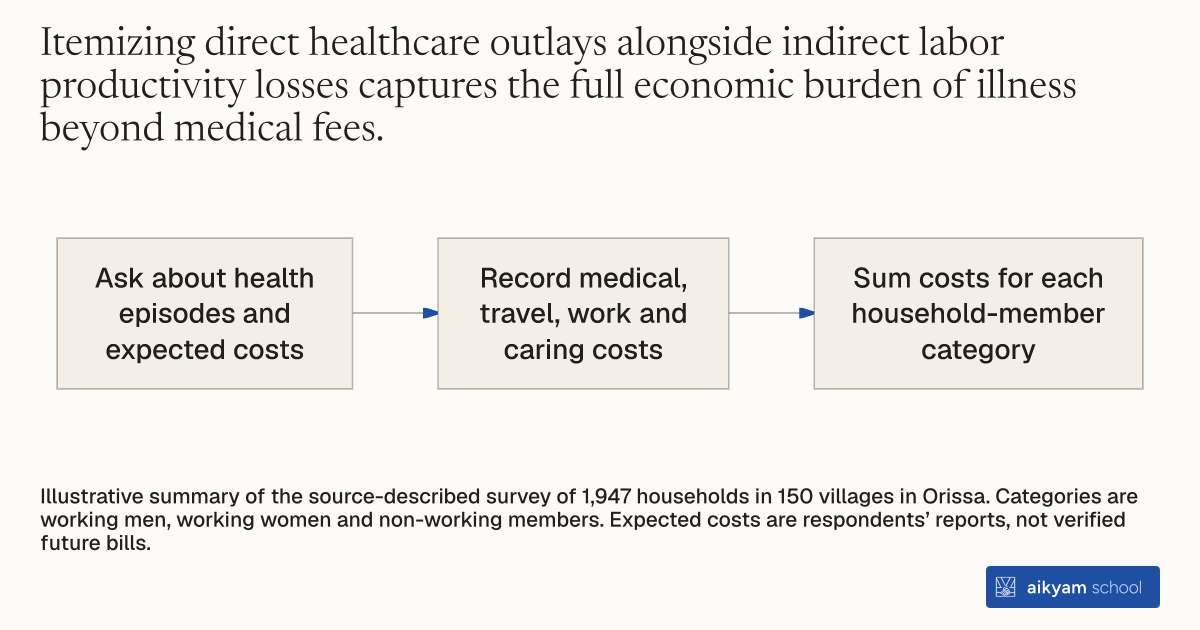
- Ask about health episodes and expected costs
- Record medical, travel, work and caring costs
- Sum costs for each household-member category
Illustrative summary of the source-described survey of 1,947 households in 150 villages in Orissa. Categories are working men, working women and non-working members. Expected costs are respondents’ reports, not verified future bills.
See source →How
When to use
Health and economic development projects need to quantify the financial burden of malaria episodes on rural households. Self-reported health assessments often omit indirect lost earnings or treatment costs across different family members. Eliciting expected direct medical expenditures and indirect productivity losses across demographic groups provides an accurate economic baseline for cost-benefit evaluations.
Quantify household economic burdens from disease episodes by administering survey modules that elicit direct medical expenditures and indirect income losses across specific household member categories.
- Administer a structured survey module to household respondents during field visits to capture past health episodes and future financial expectations.
- Itemize direct medical expenditures per malaria episode, including fees for health practitioners, prescription medications, laboratory tests, and transportation to clinics.
- Elicit indirect economic costs by recording foregone daily wages and lost working days for working men and working women during an illness episode.
- Elicit caretaking costs and lost productivity incurred by household members attending to non-working sick individuals.
- Sum direct treatment costs and indirect productivity losses to compute total expected economic cost per malaria episode across demographic groups.
Why it works
Eliciting separate costs for working men, working women, and non-working dependents accounts for wage differentials and opportunity costs across demographic roles within rural households.
Example
Surveyors interviewed adult respondents in 1,947 households across 150 rural villages in Orissa, India, in May–June 2007. Households reported an average expected total cost per malaria episode of Rs 2,791 for working men, Rs 1,897 for working women, and Rs 1,829 for non-working members.
About the study
Participants
1,947 households with 10,641 members across 150 villages in Bargarh, Balangir, Kandhamal, Keonjhar, and Sambalpur districts in Orissa, India, where 93 percent belong to Scheduled Castes, Scheduled Tribes, or Other Backward Castes.
Study Design
Surveyors administered household questionnaires eliciting direct medical outlays and indirect lost labor time to estimate mean and median expected costs per malaria episode across different demographic categories.
Results
Expected total cost per malaria episode averaged Rs 2,791 (median Rs 2,300, SD Rs 2,175) for working men, Rs 1,897 (median Rs 1,550, SD Rs 2,009) for working women, and Rs 1,829 (median Rs 1,430, SD Rs 1,801) for non-working household members.