Research procedure
Elicit hypothetical candidate choices
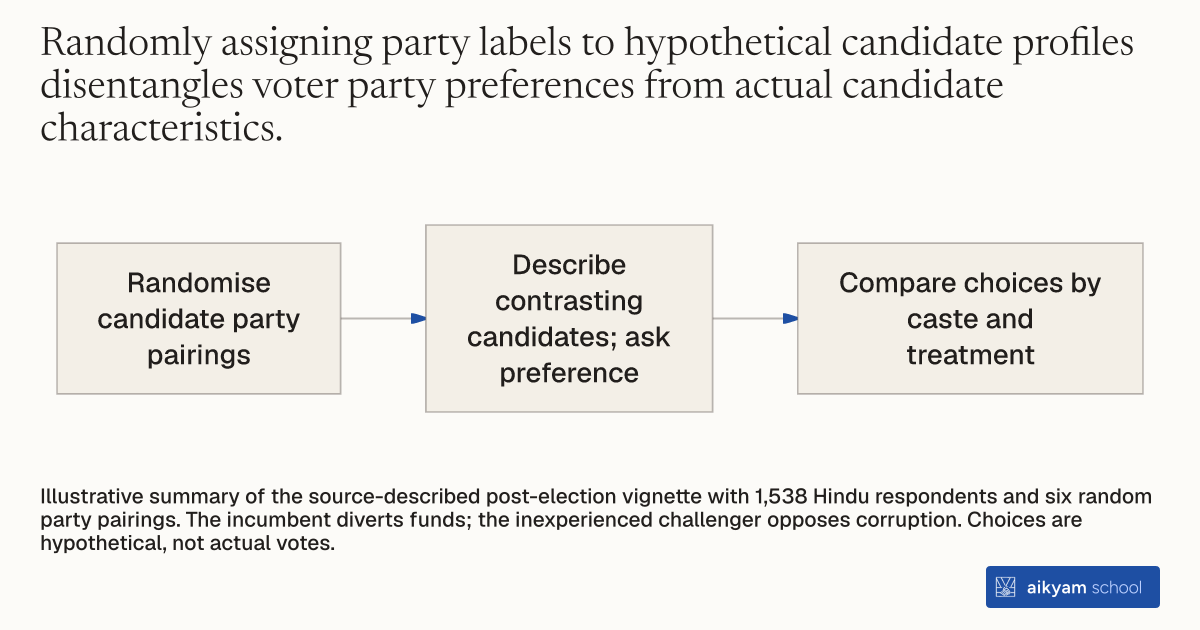
- Randomise candidate party pairings
- Describe contrasting candidates; ask preference
- Compare choices by caste and treatment
Illustrative summary of the source-described post-election vignette with 1,538 Hindu respondents and six random party pairings. The incumbent diverts funds; the inexperienced challenger opposes corruption. Choices are hypothetical, not actual votes.
See source →How
When to use
In political survey research, measuring how voters weigh candidate quality against ethnic or party loyalty is difficult using observational election data. A candidate choice trade-off vignette experiment presents respondents with hypothetical electoral choices that manipulate candidate traits, performance records, and party affiliations. This isolates how specific information about candidate quality or corruption influences voter preferences across ethnic lines.
Administer a hypothetical candidate choice vignette during a survey to evaluate how voters make trade-offs between candidate quality and ethnic preference.
- Construct a hypothetical electoral scenario describing a contest between an incumbent legislator and a political challenger in a distant constituency.
- Randomly assign party labels across respondents, pairing major competing political parties as the incumbent and opponent parties.
- Attribute contrasting traits to the candidates, depicting the incumbent as a forceful development advocate who diverts public funds and the opponent as an inexperienced challenger running on an anti-corruption platform.
- Prompt respondents to choose which candidate they would support if living in that hypothetical district.
- Record individual choices and cross-tabulate responses against respondent demographics, caste identity, and intervention treatment status.
Why it works
This allows evaluators to test whether voter preferences respond to candidate quality and whether civic campaigns reduce ethnic bias when trade-offs are explicit.
Example
During a post-election survey of 1,538 Hindu respondents in central Uttar Pradesh, researchers assigned respondents to one of six randomized party pairings for an incumbent and challenger. In control villages, respondents showed strong caste party bias, but exposure to the anti-caste campaign among lower-caste respondents significantly reduced this caste preference.
About the study
Participants
The vignette experiment sampled 1,538 Hindu respondents across 12 village units per cluster in Lalitpur, Bahraich, and Sitapur districts of Uttar Pradesh, India.
Study Design
Researchers randomly assigned each respondent to one of six candidate party combinations in a survey vignette during a post-election survey, evaluating preferences between a corrupt incumbent and an inexperienced challenger using instrumental variables regressions.
Results
Voters in control villages exhibited strong ethnic party preference for candidates from their caste-preferred party (p < 0.01), but among lower-caste voters, exposure to the anti-caste priming treatment significantly reduced this caste preference (p < 0.05). Furthermore, informing voters that their caste-preferred candidate was criminal or corrupt halved their ethnic party preference.