Research steps
Estimate the value of water collection time
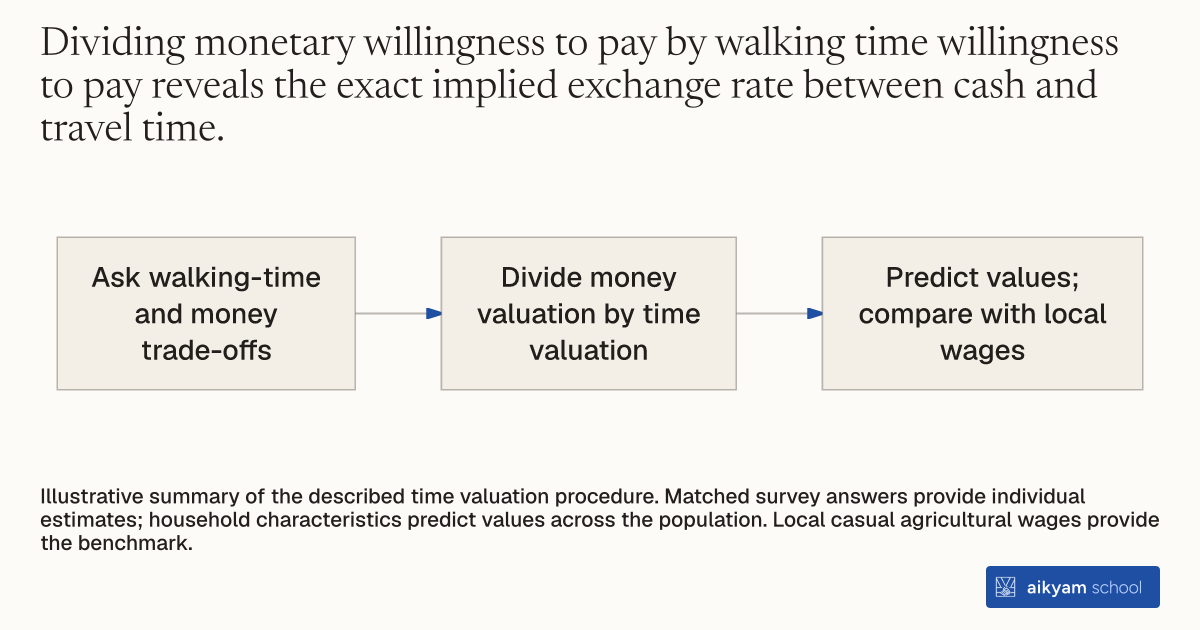
- Ask walking-time and money trade-offs
- Divide money valuation by time valuation
- Predict values; compare with local wages
Illustrative summary of the described time valuation procedure. Matched survey answers provide individual estimates; household characteristics predict values across the population. Local casual agricultural wages provide the benchmark.
See source →How
When to use
In rural developing areas, water collectors pay for water through physical travel time rather than cash. Program planners need to convert walking travel time into monetary values to evaluate water project costs and benefits. Calculating the shadow price of time connects travel time choices to real monetary willingness to pay.
Estimate the monetary value of water collection time by combining contingent valuation survey choices with local labor market wage benchmarks.
- Survey enumerators ask water collectors closed-ended questions about their willingness to walk additional travel minutes for a protected spring.
- Survey enumerators ask the same water collectors closed-ended contingent valuation questions about their monetary willingness to pay for spring protection.
- Econometricians divide each collector's monetary valuation by their walking time valuation to establish an individual shadow price of time.
- Econometricians regress these estimated time values on household demographic characteristics to predict values across the full study population.
- Econometricians compare the predicted time value against local casual agricultural labor wages to benchmark opportunity costs.
Why it works
Comparing this implied rate against local casual wages accounts for limited labor market opportunities available to rural water collectors.
Example
In rural western Kenya, researchers matched contingent valuation travel time and cash trade-off choices across a subsample of 104 respondents, finding an average estimated value of time of 0.088 US dollars per eight-hour work day, which equaled 7 percent of the average casual agricultural labor wage of 1.26 US dollars per day.
About the study
Participants
Subsample of 104 survey respondents and 1,354 panel households across 184 spring communities in Busia and Butere-Mumias districts, Kenya.
Study Design
Matched closed-ended contingent valuation elicitations for monetary and walking time trade-offs, OLS regression on household characteristics, and wage benchmarking against local casual agricultural labor.
Results
The estimated mean value of water collection time was \$0.088 USD per eight-hour work day, representing roughly 7% of the local casual agricultural labor wage (\$1.26 USD per 8-hour day based on \$0.89 USD over a 5.63-hour day).