Research steps
Measure the budget–preference gap
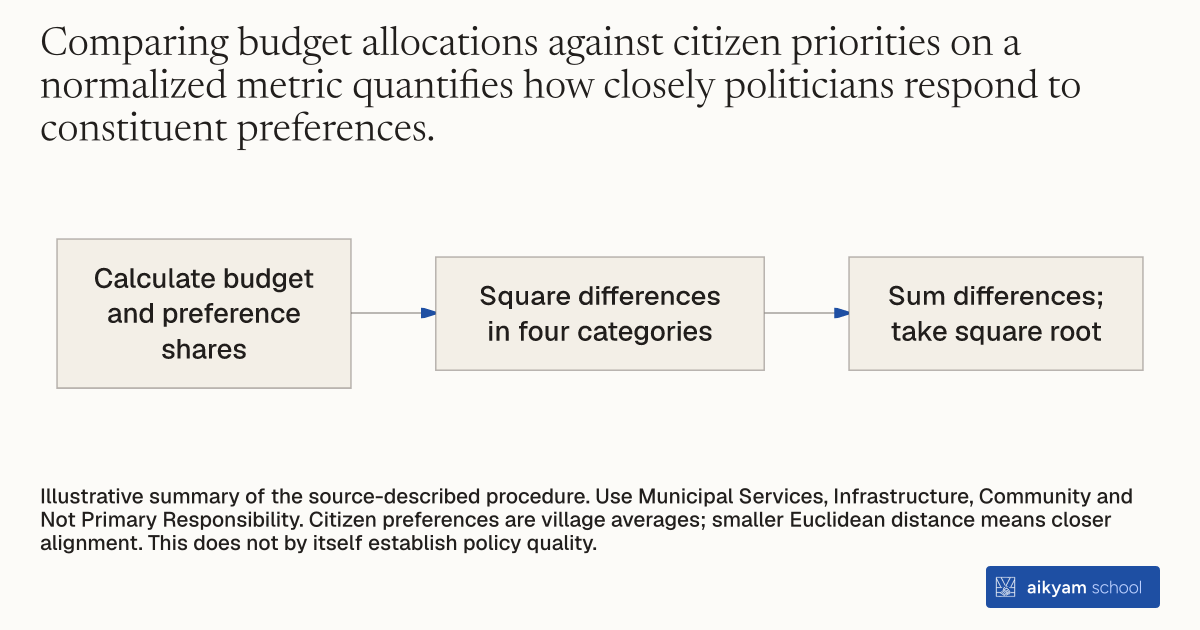
- Calculate budget and preference shares
- Square differences in four categories
- Sum differences; take square root
Illustrative summary of the source-described procedure. Use Municipal Services, Infrastructure, Community and Not Primary Responsibility. Citizen preferences are village averages; smaller Euclidean distance means closer alignment. This does not by itself establish policy quality.
See source →How
When to use
Evaluating whether elected local governments align policy decisions with public preferences is difficult when measuring political performance. Researchers need a quantitative metric to compare actual official spending against community priorities. This method calculates the gap between citizen spending preferences and municipal budget decisions across policy domains.
Calculate the Euclidean distance between official local government budget spending and citizen spending preferences across policy categories.
- Group official budget items into four broad spending categories: Municipal Services, Infrastructure, Community, and Not Primary Responsibility.
- Calculate the percentage of the official municipal budget allocated to each category in each village.
- Conduct a survey asking a sample of village citizens to allocate a hypothetical budget across the same four categories.
- Calculate the village-level average percentage preferred by citizens for each category.
- Compute the quadratic distance for each category by taking the squared difference between actual budget percentage and average preferred percentage.
- Calculate the total Euclidean distance for each village by taking the square root of the sum of squared differences across all four categories.
Why it works
A smaller Euclidean distance indicates higher policy alignment and greater responsiveness to community needs.
Example
In Khyber Pakhtunkhwa province, Pakistan, researchers measured policy alignment across 189 village councils one year after elections. Delivering public social messages reduced the Euclidean distance between council spending and citizen preferences by 18.219 points compared to public personal status messages.
About the study
Participants
189 village councils and 1,318 surveyed citizens in Haripur and Abbottabad districts, Khyber Pakhtunkhwa province, Pakistan.
Study Design
A randomized field experiment collecting official annual municipal budget documents and surveying citizens one year post-election to calculate the Euclidean distance across four spending categories.
Results
Social messaging versus personal status messaging reduced the Euclidean distance between council budgets and citizen preferences by 9.4 points overall (p = 0.04) and by 18.219 points when messaging was delivered in public meetings alone (p = 0.027).