Research scoring
Compare voter and candidate priorities
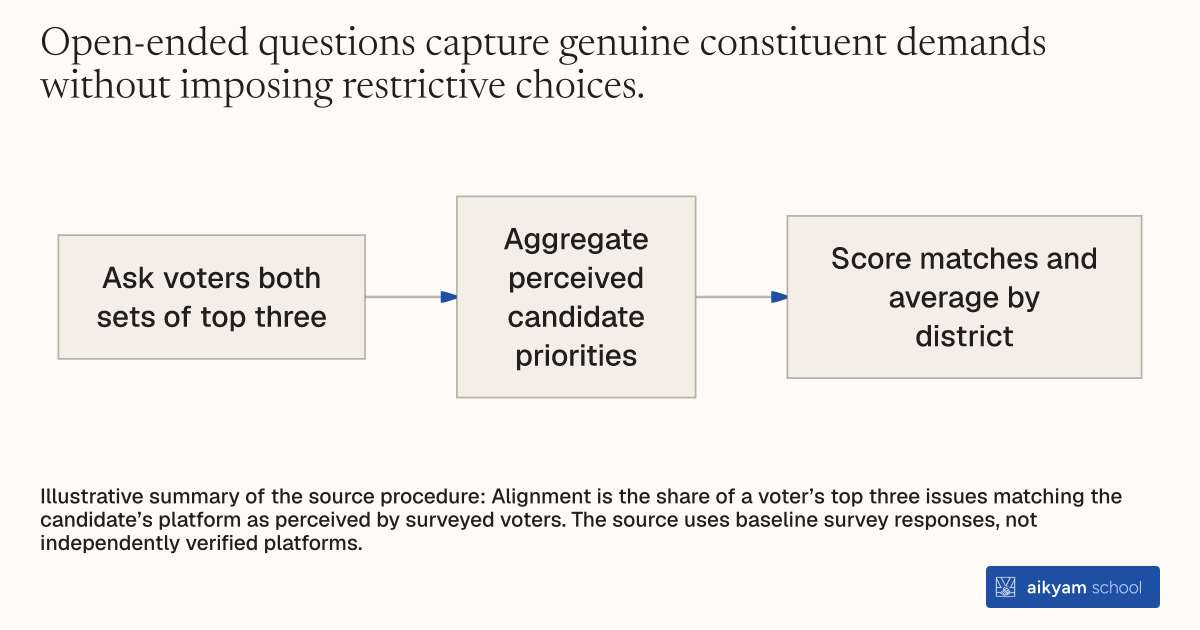
- Ask voters both sets of top three
- Aggregate perceived candidate priorities
- Score matches and average by district
Illustrative summary of the source procedure: Alignment is the share of a voter’s top three issues matching the candidate’s platform as perceived by surveyed voters. The source uses baseline survey responses, not independently verified platforms.
See source →How
When to use
In clientelistic elections, voters often lack clear information on whether candidate policy priorities match local community needs. Researchers and program evaluators need a systematic metric to measure policy congruence between voters and candidates without introducing researcher bias. This method calculates preference alignment scores using open-ended constituent survey responses.
Calculate constituent-candidate policy alignment scores by comparing individual voter priorities against aggregated candidate platforms.
- Survey enumerators ask registered voters open-ended questions to name their top three development priorities for their district.
- Enumerators ask voters to state what they believe are the top three development priorities for each predicted leading candidate.
- Analysts aggregate voter responses across each district to identify the primary policy priorities for each candidate.
- Analysts calculate individual preference alignment as the proportion of a voter's top three priority issues that match the candidate's aggregated platform.
- Analysts average individual alignment scores at the district level to establish overall constituency preference match scores.
Why it works
Aggregating voter perceptions of candidate positions generates an objective platform measure to evaluate political congruence.
Example
Researchers scored policy preference alignment between 4,060 registered voters and legislative candidates across 73 electoral districts in Liberia during the 2017 election. Interacting policy alignment with debate exposure showed that incumbents whose platforms matched voter priorities gained 4.1 percentage points in individual vote choice.
About the study
Participants
4,060 registered voters and predicted leading candidates across 73 electoral districts in Liberia during the 2017 election.
Study Design
Panel survey preference matching calculating individual and district policy alignment z-scores from open-ended baseline survey questions.
Results
Interacting treatment assignment with policy match increased individual incumbent vote choice by 4.1 percentage points; complier incumbents exhibited policy match z-scores of -0.22 compared to -1.38 for complier challengers.