Research design
Randomise water connection encouragement
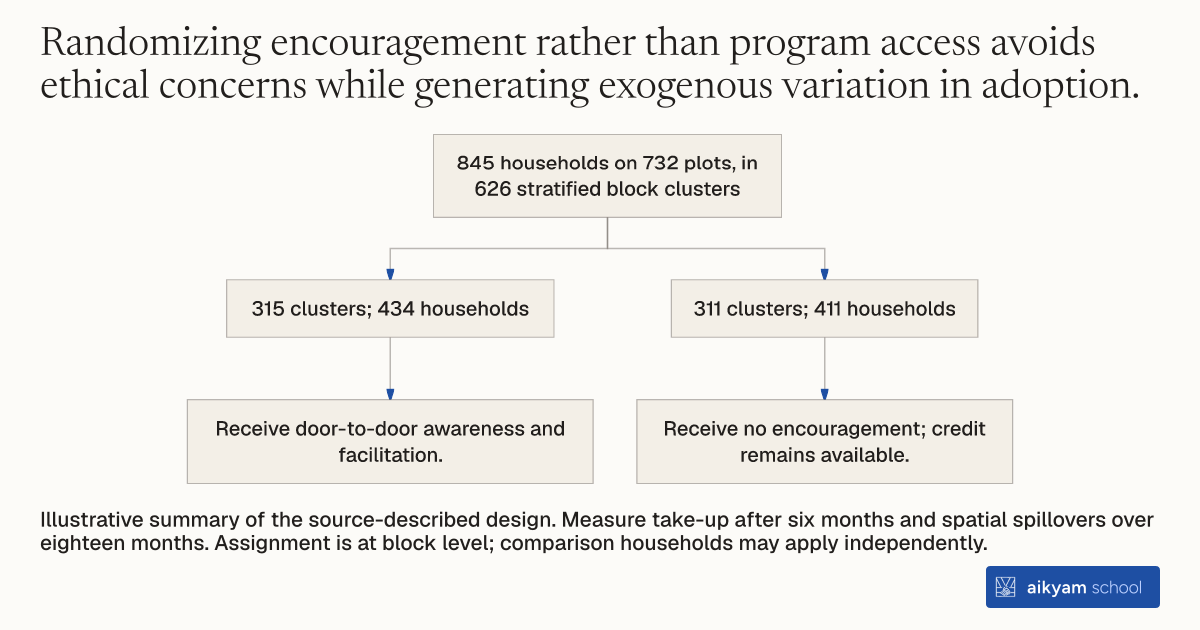
845 households on 732 plots, in 626 stratified block clusters
- 315 clusters; 434 households
- Receive door-to-door awareness and facilitation.
- 311 clusters; 411 households
- Receive no encouragement; credit remains available.
Illustrative summary of the source-described design. Measure take-up after six months and spatial spillovers over eighteen months. Assignment is at block level; comparison households may apply independently.
See source →How
When to use
Public utility programs often cannot ethically or practically deny service to control groups during an expansion. This method uses a block-level cluster randomized encouragement design to test voluntary program adoption among low-income households. It allows researchers to evaluate credit demand and long-term spillovers without withholding utility eligibility from anyone.
Evaluate program demand and spillovers by randomly assigning geographic block clusters to receive intensive outreach encouragement.
- Group adjacent target residential plots into geographic block clusters based on spatial proximity.
- Stratify the clusters by neighborhood location, baseline water source, presence of young children, and household count.
- Randomly assign half of the clusters to receive a door-to-door encouragement campaign and the remaining half to serve as a comparison group.
- Leave public credit programs universally accessible so comparison households can still apply on their own initiative.
- Measure immediate take-up differences between encouragement and comparison groups after six months.
- Track geographic neighbor proximity using spatial coordinates to measure social diffusion and spillovers over eighteen months.
Why it works
Clustering at the intermediate block level prevents immediate contamination between neighbor households while enabling measurement of spatial diffusion over time.
Example
In Tangiers, Morocco, researchers grouped 732 eligible plots into 626 block clusters and randomly assigned 315 clusters (434 households) to receive encouragement and 311 clusters (411 households) to the comparison group. Six months later, 68.7 percent of encouraged households had purchased a water connection compared to 9.7 percent of control households.
About the study
Participants
845 low-income households across 732 plots grouped into 626 block clusters in Tangiers, Morocco.
Study Design
Block-level cluster randomized encouragement trial stratified by location, water source, child count, and cluster size, with spatial spillover tracking.
Results
The encouragement intervention increased connection take-up from 9.7 percent in the control group to 68.7 percent in the treatment group, and nearby control households within 20 meters of a treated neighbor were 18 percentage points more likely to adopt after 18 months.