Research procedure
Budget the cost of peer information
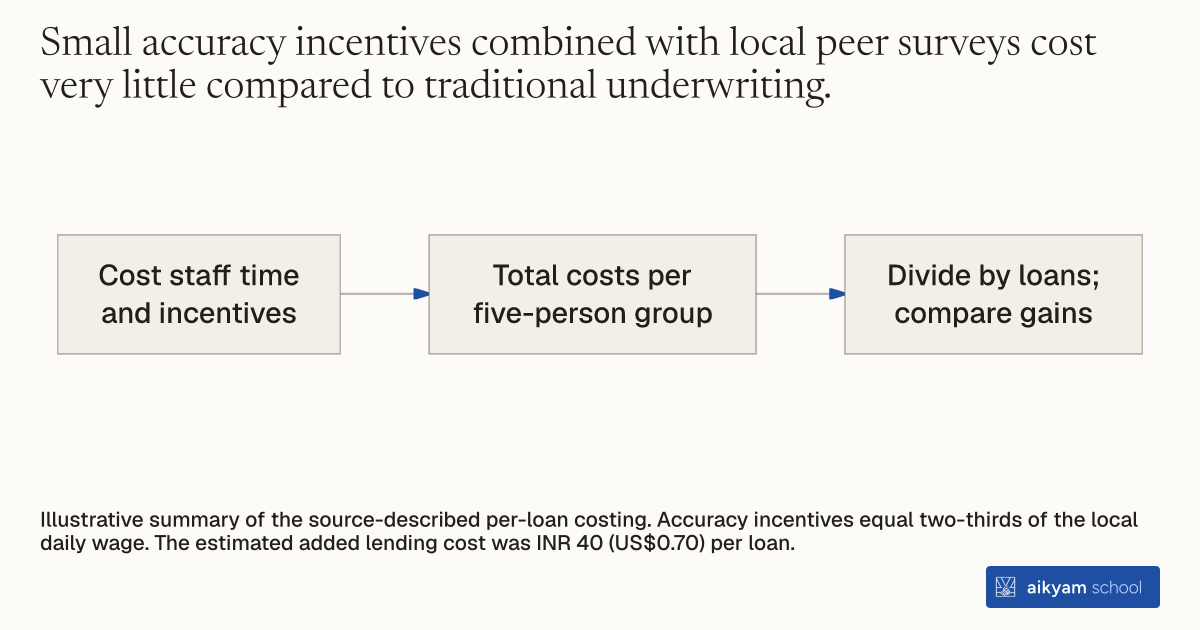
- Cost staff time and incentives
- Total costs per five-person group
- Divide by loans; compare gains
Illustrative summary of the source-described per-loan costing. Accuracy incentives equal two-thirds of the local daily wage. The estimated added lending cost was INR 40 (US$0.70) per loan.
See source →How
When to use
Lenders and microfinance institutions face tight administrative budgets when assessing microloan applicants. Formal financial audits cost too much for tiny loans. Estimating the per-loan cost of peer surveys provides a practical way to acquire screening data within budget limits.
Calculate and budget the per-loan administrative cost of collecting incentivized community peer information during credit underwriting.
- Determine the baseline labor cost for field staff administering peer ranking surveys.
- Budget an accuracy-calibrated incentive payout per respondent equal to two-thirds of the local daily wage.
- Calculate the total survey and incentive expense for a five-person peer group.
- Divide group administration costs across planned loan disbursements to find the marginal cost per loan.
- Compare incremental per-loan survey costs against projected profit returns from improved targeting before scaling field operations.
Why it works
Budgeting these small marginal costs allows credit institutions to improve targeting efficiency without straining operating budgets.
Example
Researchers calculated the marginal cost of collecting peer survey data with accuracy incentives across 274 peer groups in Amravati, Maharashtra, India. Adding incentivized peer surveys increased lending costs by only 40 Indian rupees (0.70 US dollars) per loan. This nominal expense was far lower than the 24 to 30 percent monthly returns achieved by top-ranked entrepreneurs.
About the study
Participants
1,345 households in 274 peer groups across nine peri-urban neighborhoods in Amravati, Maharashtra, India.
Study Design
Cost-benefit calculation estimating incremental per-loan survey administration and incentive expenses relative to generated business profit returns.
Results
Collecting community peer information and providing accuracy incentives added an estimated 40 Indian rupees (0.70 US dollars) per loan, yielding monthly returns of 24 to 30 percent among top-ranked microentrepreneurs.