Research steps
Measure public-service attitudes before messages
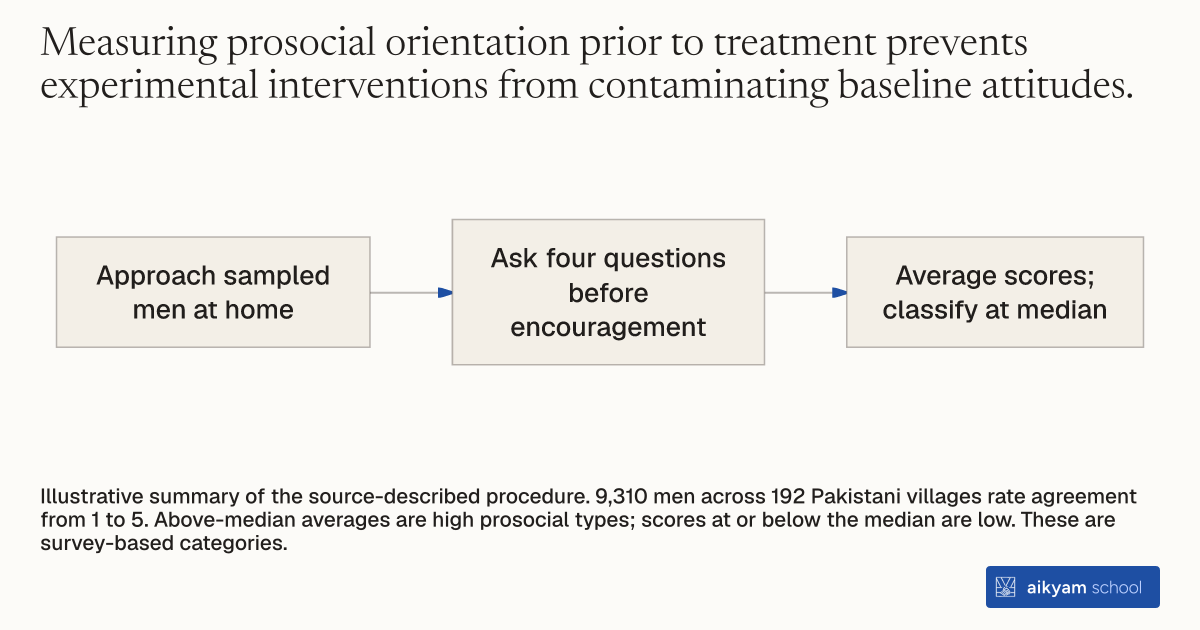
- Approach sampled men at home
- Ask four questions before encouragement
- Average scores; classify at median
Illustrative summary of the source-described procedure. 9,310 men across 192 Pakistani villages rate agreement from 1 to 5. Above-median averages are high prosocial types; scores at or below the median are low. These are survey-based categories.
See source →How
When to use
In political selection research, identifying whether messaging attracts public-spirited individuals requires measuring citizens' baseline prosociality before candidate recruitment activities. Standard self-reports suffer from post-treatment bias if measured after recruitment drives. Conducting a short intake survey before delivering encouragements measures prospective candidates' prosocial orientation ex-ante.
Administer a brief intake survey before delivering experimental encouragements to assess prospective candidates' prosocial orientation.
- Approach sampled male citizens at their home dwellings using a random walk procedure from the village center.
- Conduct a short intake survey prior to delivering any experimental recruitment messages.
- Ask respondents to rate their agreement on a scale of 1 to 5 with four core statements about public service, helping others, public goods, and representative performance.
- Calculate each individual's average score across the four survey questions.
- Code respondents with above-median average scores as high prosocial types and those at or below the median as low prosocial types.
Why it works
Categorizing respondents into high and low prosocial types allows researchers to evaluate whether recruitment messaging selectively motivates civic-minded citizens to enter political races.
Example
In Haripur and Abbottabad districts of Pakistan, enumerators surveyed 9,310 male citizens before delivering candidacy treatments. High prosocial types comprised 38.6 percent of the sample, and social versus personal messaging increased candidacy among these prosocial citizens by 2.6 percentage points and election by 1.6 percentage points.
About the study
Participants
9,310 male citizens across 192 villages in Haripur and Abbottabad districts, Khyber Pakhtunkhwa province, Pakistan.
Study Design
A short intake survey administered at baseline prior to randomized private and public encouragement treatments, using median splits across four Likert-scale questions to categorize high versus low prosocial orientation.
Results
High prosocial orientation was identified in 38.6 percent of the sample (N = 9,310); social versus personal messaging increased candidacy among high prosocial types by 2.6 percentage points (p = 0.035) and election probability by 1.6 percentage points (p = 0.0578).