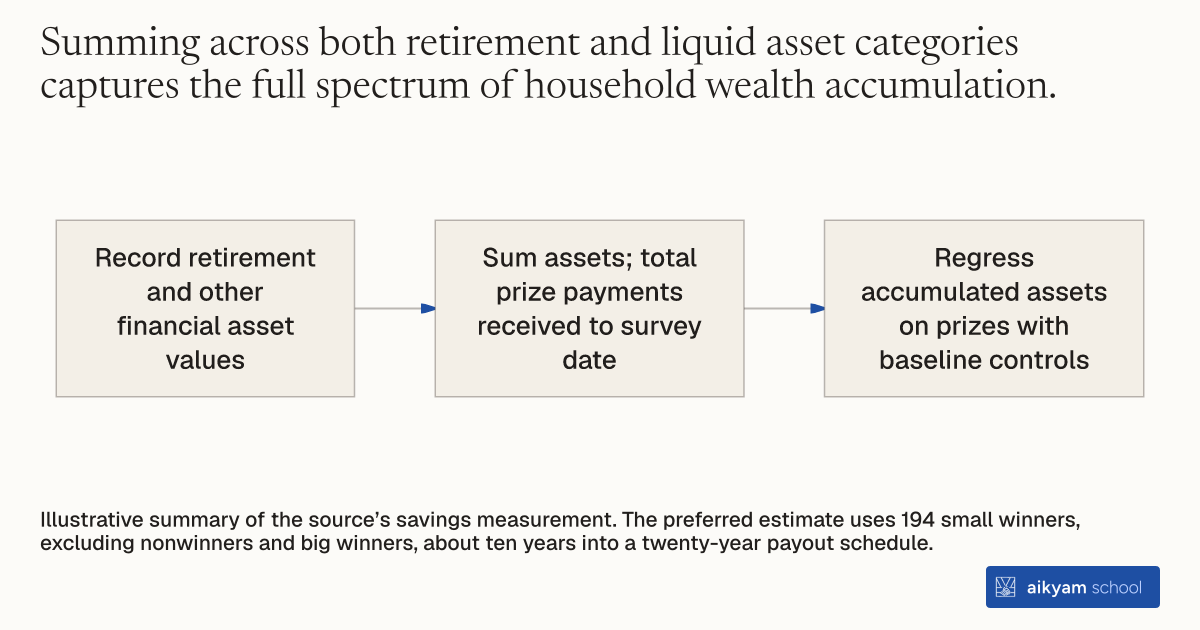
Research procedure
Estimate savings from accumulated prizes
- Record retirement and other financial asset values
- Sum assets; total prize payments received to survey date
- Regress accumulated assets on prizes with baseline controls
Illustrative summary of the source’s savings measurement. The preferred estimate uses 194 small winners, excluding nonwinners and big winners, about ten years into a twenty-year payout schedule.
See source →How
When to use
Researchers and financial planners need to evaluate how households save multi-year cash transfers over extended horizons. Standard cross-sectional surveys often fail to capture long-term asset accumulation across distinct financial vehicles. Summing accumulated retirement, stock, and liquid savings accounts midway through multi-year payouts isolates the marginal propensity to save out of unearned income.
Measure accumulated household wealth by inventorying liquid and retirement financial assets across survey respondents receiving multi-year cash payments.
- Design survey modules querying holdings across retirement accounts, mutual funds, stocks, bonds, and cash savings.
- Calculate total accumulated unearned income received by respondents from initial prize award through the survey date.
- Sum reported financial asset values across retirement and non-retirement accounts for each household.
- Regress total accumulated financial assets on total accumulated prize payouts while controlling for baseline pre-winning demographic variables.
- Derive the marginal propensity to save parameter by dividing estimated asset accumulation by total received payouts.
Why it works
Comparing total saved assets against cumulative unearned cash received reveals the structural proportion preserved for long-term consumption smoothing.
Example
Researchers surveyed 194 small lottery winners in Massachusetts receiving yearly payouts over a 20-year schedule. Evaluating total financial assets accumulated 10 years into the payout period demonstrated that winners saved approximately 16 percent of their cumulative unearned prize money.
About the study
Participants
194 lottery winners (receiving under 100,000 dollars per year) in Massachusetts evaluated midway through a 20-year payout schedule.
Study Design
Cross-sectional OLS regression of accumulated financial wealth (retirement and non-retirement assets) on cumulative unearned lottery payouts received through the survey date.
Results
Unearned lottery payouts generated a marginal propensity to save of 15.8 percent (standard error 5.6 percent) out of total accumulated prize money received.