Research procedure
Track exhaled carbon monoxide
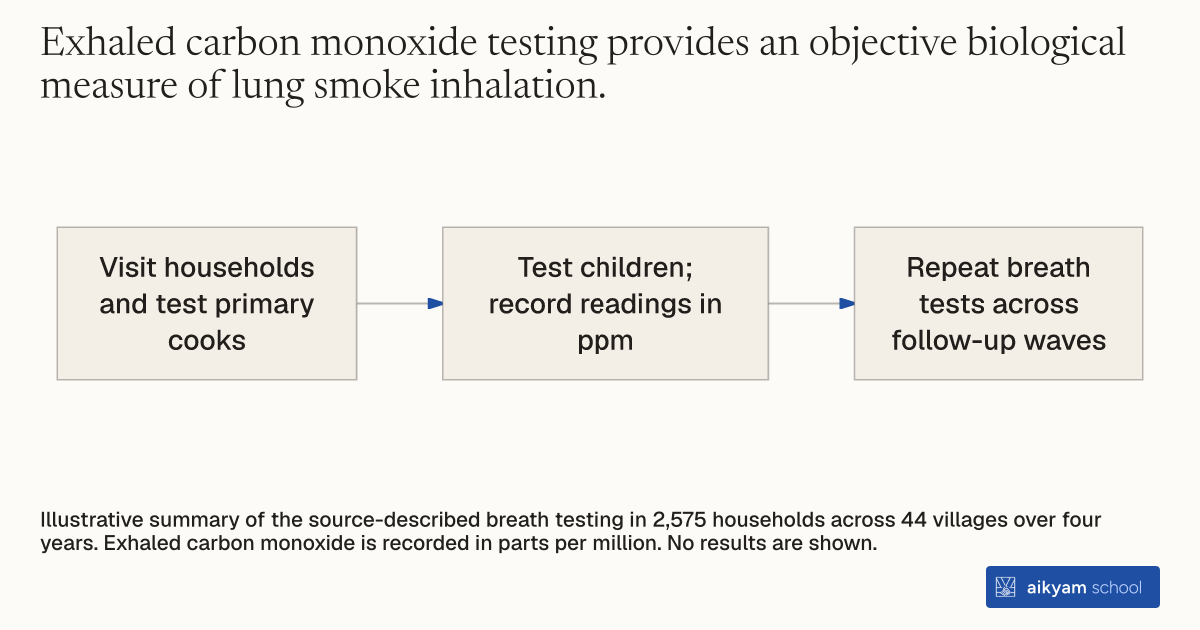
- Visit households and test primary cooks
- Test children; record readings in ppm
- Repeat breath tests across follow-up waves
Illustrative summary of the source-described breath testing in 2,575 households across 44 villages over four years. Exhaled carbon monoxide is recorded in parts per million. No results are shown.
See source →How
When to use
Rural households burn biomass fuels, creating high levels of indoor smoke that threaten respiratory health. Self-reported health symptoms often fail to reflect actual biological smoke inhalation among primary cooks and young children. Field teams use breath testing to measure carbon monoxide levels directly in lungs to establish baseline pollution exposure.
Measure smoke inhalation directly from lung tissue by testing carbon monoxide levels in exhaled breath.
- Field evaluators visit sampled households in rural target villages across evaluation waves.
- Evaluators instruct the household primary cook to exhale completely into a portable testing device to measure carbon monoxide in parts per million.
- Evaluators repeat the breath testing procedure for young children present in the household.
- Evaluators record the baseline carbon monoxide readings in parts per million for each tested individual.
- Evaluators re-test household members across follow-up survey waves over four years to measure changes in smoke exposure over time.
Why it works
This biomarker eliminates self-reporting bias and reveals true physiological exposure to biomass pollution.
Example
Researchers in Orissa, India tested 2,575 households across 44 villages to establish baseline lung smoke levels. Primary cooks recorded an average exhaled carbon monoxide reading of 7.77 ppm, while children recorded an average of 6.48 ppm. In the first year of clean stove eligibility, carbon monoxide exposure for primary cooks fell by 7.5 percent, but this reduction disappeared in subsequent years as stove maintenance and proper usage declined.
About the study
Participants
2,575 households in 44 rural villages, Orissa, India.
Study Design
Four-year longitudinal Randomized Controlled Trial (RCT) measuring exhaled breath carbon monoxide across public lottery evaluation waves.
Results
Primary cooks showed an average baseline carbon monoxide reading of 7.77 ppm and children showed 6.48 ppm. Primary cook carbon monoxide exposure fell by 7.5 percent during year one, but showed no significant change for children and no long-run reduction after year one.