Try, learn and adjust
Check clinic performance gaps before joint planning
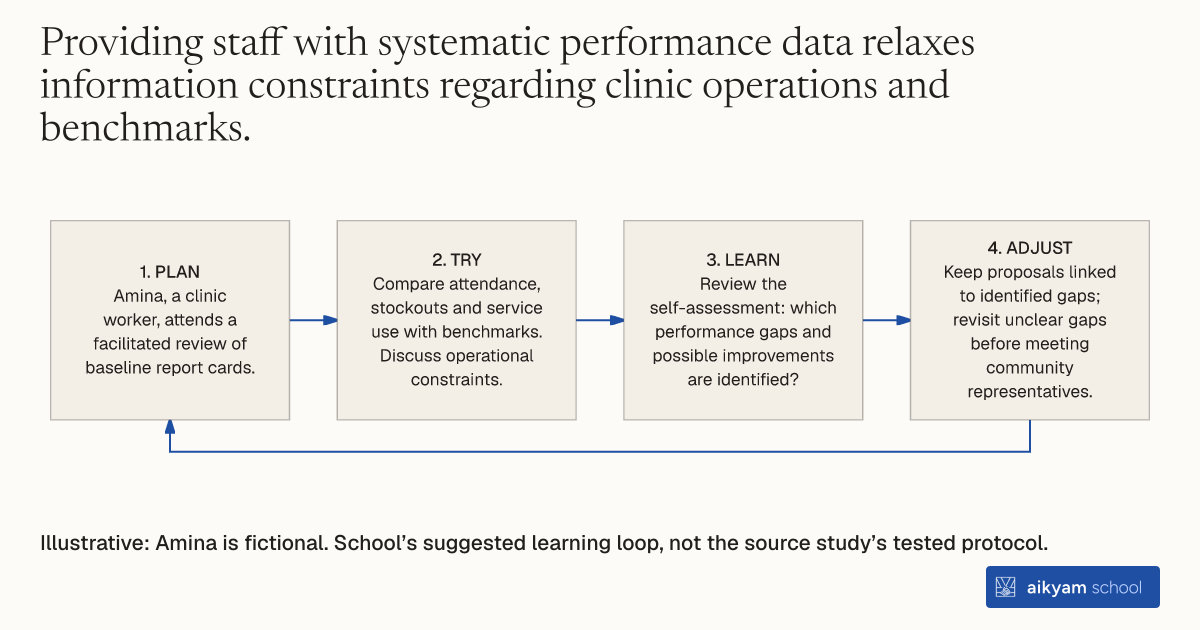
- Plan: Amina, a clinic worker, attends a facilitated review of baseline report cards.
- Try: Compare attendance, stockouts and service use with benchmarks. Discuss operational constraints.
- Learn: Review the self-assessment: which performance gaps and possible improvements are identified?
- Adjust: Keep proposals linked to identified gaps; revisit unclear gaps before meeting community representatives.
Illustrative: Amina is fictional. School’s suggested learning loop, not the source study’s tested protocol.
See source →School’s suggested loop, not a tested source procedure. Observe staff comparisons, constraints and improvement proposals; do not attribute package effects to this meeting alone.
How
When to use
Primary health care workers in rural clinics often operate with low effort, high absenteeism, and limited internal feedback on facility performance. This lack of structured performance reflection leaves staff unaware of citizen dissatisfaction or gaps between national health benchmarks and daily clinic operations. This method uses a facilitated internal review meeting to present baseline report card metrics to clinic workers and prompt self-assessment before engaging with community members.
Convene and facilitate a dedicated meeting with primary health clinic staff to review baseline facility performance indicators and discuss service delivery gaps.
- CBO facilitators assemble baseline service provision and utilization data into facility-specific report cards.
- CBO facilitators convene health clinic staff at the primary dispensary for an internal review meeting.
- CBO facilitators present facility report card metrics on outpatient visits, immunization rates, drug stockouts, and provider attendance.
- CBO facilitators guide health facility staff through comparing their recorded performance against standard health sector benchmarks and regional averages.
- Health workers examine internal operational constraints, resource shortages, and professional practices contributing to observed performance gaps.
- Health facility staff formulate an internal baseline self-assessment and outline potential operational improvements ahead of joint discussions with community representatives.
Why it works
It creates internal awareness among providers about service deficits, preparing them to constructively participate in shared action planning with community members.
Example
In 25 rural public primary health dispensaries in Uganda, CBO facilitators conducted internal staff review meetings using baseline report cards. Following the full intervention series, treatment health facilities demonstrated higher provider effort, resulting in monthly deliveries rising from 9.2 in control facilities to 15.5 in treatment facilities, and monthly outpatient visits increasing from 661 to 768.
About the study
Participants
50 public primary health dispensaries and their corresponding catchment areas across 9 rural districts covering all four regions of Uganda.
Study Design
Randomized field experiment evaluating a series of facilitated meetings (staff meeting, community meeting, interface meeting) across 25 treatment facilities and 25 control facilities.
Results
Post-intervention monthly outpatient care reached 768 patients in treatment facilities compared to 661 in control facilities (difference of 107), and monthly deliveries reached 15.5 in treatment facilities compared to 9.2 in control facilities (difference of 6.3).