Try, learn and adjust
Check women can access adapted public work
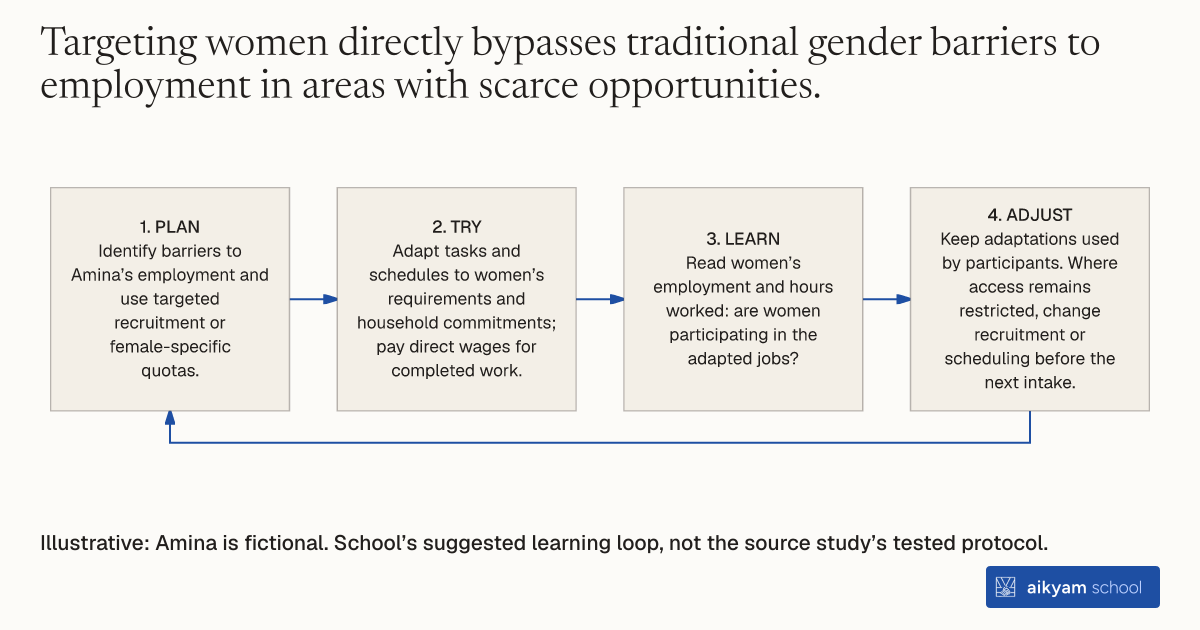
- Plan: Identify barriers to Amina’s employment and use targeted recruitment or female-specific quotas.
- Try: Adapt tasks and schedules to women’s requirements and household commitments; pay direct wages for completed work.
- Learn: Read women’s employment and hours worked: are women participating in the adapted jobs?
- Adjust: Keep adaptations used by participants. Where access remains restricted, change recruitment or scheduling before the next intake.
Illustrative: Amina is fictional. School’s suggested learning loop, not the source study’s tested protocol.
See source →School’s suggested learning loop: observe women’s participation, hours and wage payments; this check does not establish programme impact.
How
When to use
Increase female labor force participation in areas with low employment rates and limited job opportunities for women. Overcome socio-cultural and structural barriers that prevent women from accessing formal work. Ensure social protection programs benefit marginalized female community members alongside male workers.
Target women with gender-adapted recruitment strategies and work opportunities within public works programs.
- Identify geographic regions where women experience low employment rates and restricted economic options.
- Establish female-specific recruitment quotas or targeted enrollment campaigns for public works projects.
- Design project tasks and flexible schedules that accommodate women's physical requirements and household commitments.
- Hire local female participants into designated public works positions alongside male workers.
- Pay women direct cash wages for completed days of program labor.
Why it works
Dedicated work roles allow women to enter the local workforce and earn independent household income.
Example
In the Democratic Republic of the Congo, female-targeted public works recruitment increased female employment, driving the overall program increases in participants' likelihood of being employed and total hours worked.
About the study
Participants
Female public works participants in areas with low female employment in the Democratic Republic of the Congo, Egypt, Sierra Leone, and Tunisia.
Study Design
Randomized controlled trial measuring gender-disaggregated labor market participation, employment probability, and total working hours.
Results
In the Democratic Republic of the Congo, increases in women's employment drove overall program increases in participant employment probability and average hours worked.