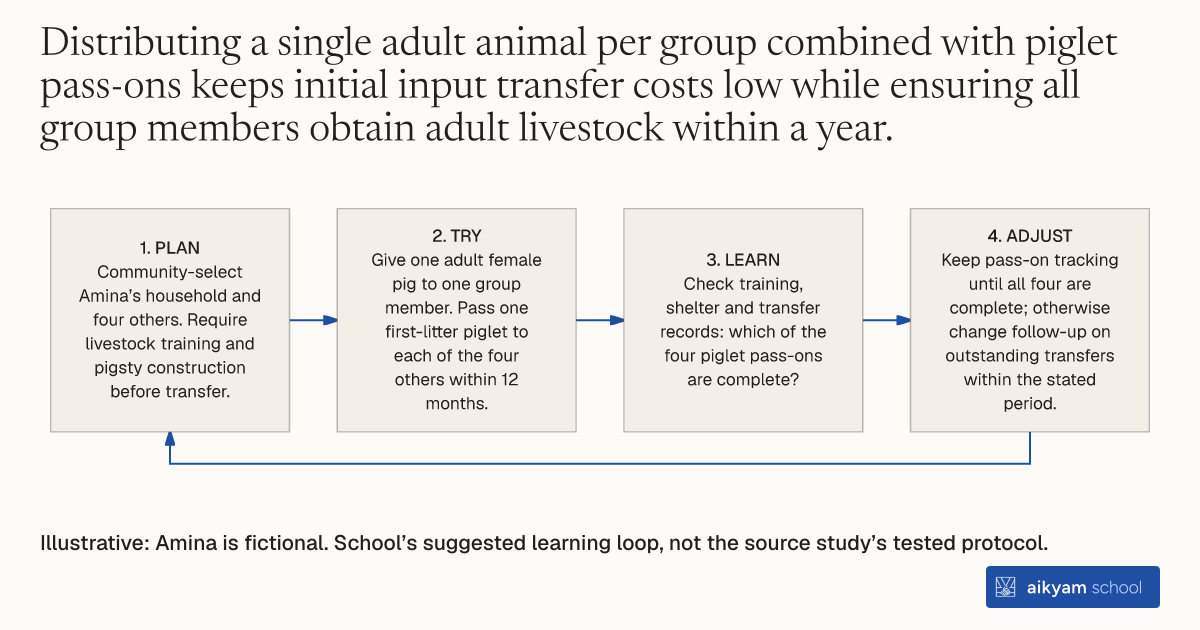
Try, learn and adjust
Check livestock pass-ons reach all group members
- Plan: Community-select Amina’s household and four others. Require livestock training and pigsty construction before transfer.
- Try: Give one adult female pig to one group member. Pass one first-litter piglet to each of the four others within 12 months.
- Learn: Check training, shelter and transfer records: which of the four piglet pass-ons are complete?
- Adjust: Keep pass-on tracking until all four are complete; otherwise change follow-up on outstanding transfers within the stated period.
Illustrative: Amina is fictional. School’s suggested learning loop, not the source study’s tested protocol.
See source →School’s suggested, untested learning loop. Observe training, pigsties and piglet transfers. This suggested loop does not repeat initial allocation or establish livestock-value effects.
How
When to use
Rural smallholder households in low-income regions often lack the capital needed to purchase productive livestock assets. Distributing adult livestock to every family in a village is prohibitively expensive for development programmes. This pass-on model enables community-selected households to receive livestock at a low initial cost by sharing piglets across five-household groups.
Distribute small livestock to selected households using a five-member group pass-on model to expand livestock ownership across the community.
- Select target beneficiaries, such as female-headed or youth-headed households, through community decision-making in the village.
- Require selected households to attend a livestock management training session and construct a pigsty before receiving animals.
- Form groups of 5 selected households in the village.
- Transfer one adult female pig to one primary member in each five-household group.
- Pass on one piglet from the first litter produced by the adult pig to each of the four remaining group members within 12 months.
Why it works
Requiring pre-transfer training and pigsty construction ensures proper animal shelter and reduces livestock mortality.
Example
In rural western Uganda, Raising the Village introduced pigs to selected households using a five-household group pass-on model, contributing to an overall livestock value increase of USD 183.734 PPP per household across treated communities.
About the study
Participants
3,852 households across 335 villages in Kagadi and Kyenjojo districts, western Uganda, where 35% of households fall below the \$2.15 PPP daily poverty line post-harvest and 65% during the lean season.
Study Design
Clustered randomized controlled trial across 114 village clusters covering 335 villages, comparing a universal livelihoods program to a pure control group.
Results
Value of pig holdings increased by USD 46.345 PPP (p < 0.01), pig quantity increased by 0.368 animals (p < 0.01), and total livestock holdings increased by USD 183.734 PPP (p < 0.01).