Try, learn and adjust
Check the next camp runs as announced
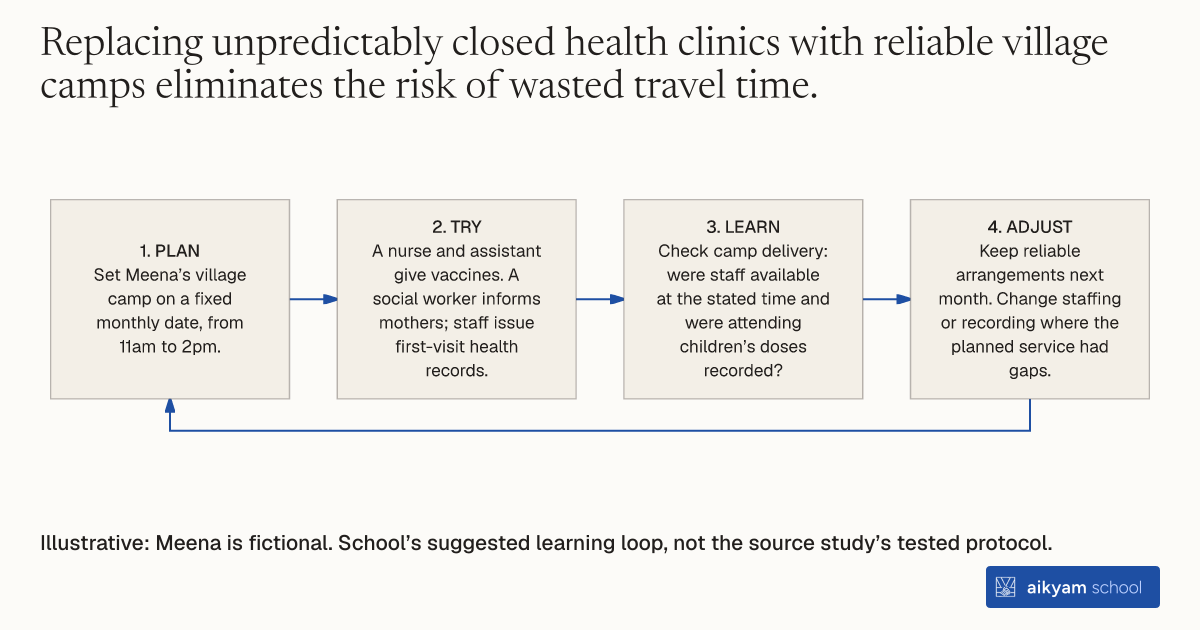
- Plan: Set Meena’s village camp on a fixed monthly date, from 11am to 2pm.
- Try: A nurse and assistant give vaccines. A social worker informs mothers; staff issue first-visit health records.
- Learn: Check camp delivery: were staff available at the stated time and were attending children’s doses recorded?
- Adjust: Keep reliable arrangements next month. Change staffing or recording where the planned service had gaps.
Illustrative: Meena is fictional. School’s suggested learning loop, not the source study’s tested protocol.
See source →School’s suggested, untested loop. Observe scheduled service, staff presence and vaccination entries. This delivery loop is not a clinical protocol.
How
When to use
Public health clinics in rural areas suffer from high staff absenteeism, leaving parents unsure whether facilities will be open. Parents procrastinate on child vaccinations because visiting unpredictably closed health centers is inconvenient and unreliable. This method provides dependable, localized preventive healthcare for children in remote rural communities.
Hold regular monthly mobile health camps in rural villages to provide consistent and accessible child immunizations.
- A mobile immunization team sets up a camp in each village on a fixed date of the month.
- Nurses and assistants staff the camp from 11 a.m. to 2 p.m. to administer standard child vaccines.
- A local social worker informs village mothers about the upcoming camp date and explains the health benefits of vaccination.
- Staff issue an official immunization tracking card to each child upon receiving their first injection.
Why it works
Knowing that health workers will appear on a fixed schedule makes taking a child for vaccination predictable and convenient.
Example
Seva Mandir conducted monthly mobile immunization camps from 11 a.m. to 2 p.m. across 30 rural villages in Udaipur, India. The reliable camps increased the proportion of children receiving at least one vaccine from 6 percent in comparison villages to 78 percent. However, without additional incentives, full immunization coverage across all required doses reached only 18 percent.
About the study
Participants
134 rural villages in Udaipur, India, focusing on families with children aged 1 to 3 years.
Study Design
Clustered randomized controlled evaluation comparing 30 villages with immunization camps, 30 villages with camps plus incentives, and 74 comparison villages.
Results
Reliable mobile camps increased the rate of children receiving at least one vaccine to 78 percent, and tripled the full immunization rate from 6 percent to 18 percent.