Try, learn and adjust
Use buyer feedback on the next rug shipment
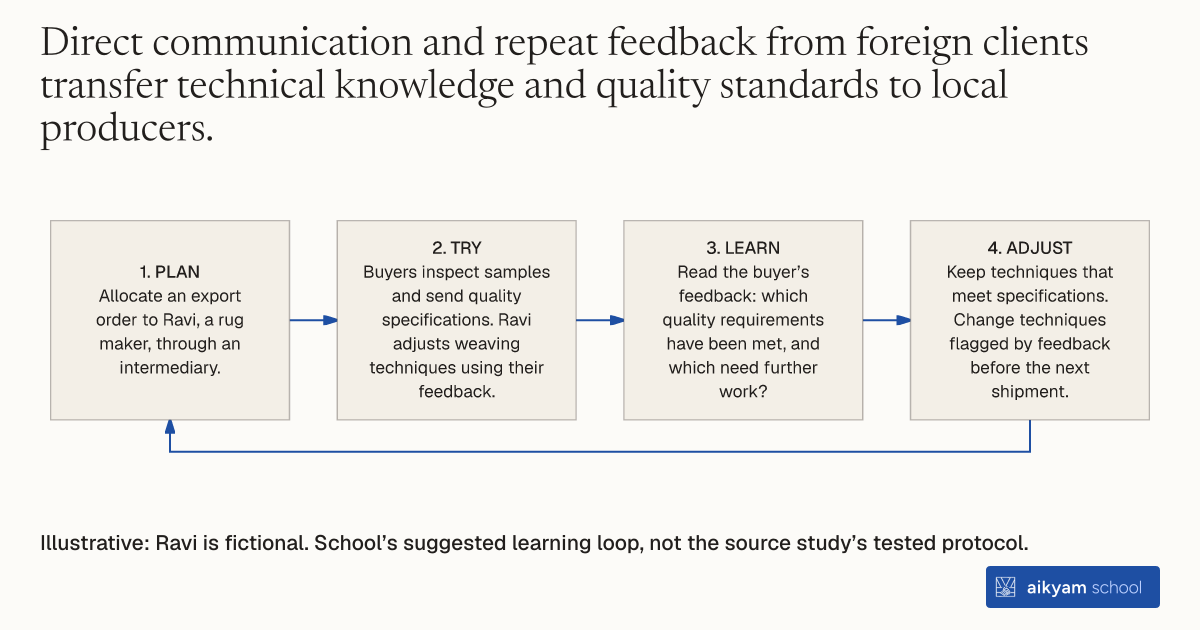
- Plan: Allocate an export order to Ravi, a rug maker, through an intermediary.
- Try: Buyers inspect samples and send quality specifications. Ravi adjusts weaving techniques using their feedback.
- Learn: Read the buyer’s feedback: which quality requirements have been met, and which need further work?
- Adjust: Keep techniques that meet specifications. Change techniques flagged by feedback before the next shipment.
Illustrative: Ravi is fictional. School’s suggested learning loop, not the source study’s tested protocol.
See source →School’s suggested, untested loop. Observe sample quality and buyer feedback; this loop does not establish a profit increase.
How
When to use
Small manufacturing firms in lower-income countries often struggle to enter foreign markets and improve product quality. They lack direct contact with foreign clients who can specify higher quality standards and provide technical feedback. Facilitating export orders with structured feedback helps small producers upgrade their production techniques and increase profits.
Connect small domestic producers directly with foreign buyers through export orders and structured feedback channels.
- Intermediaries identify international clients in high-income markets seeking artisanal or manufactured goods.
- Intermediaries secure export orders and allocate production contracts to local microenterprises.
- Foreign buyers inspect sample shipments and communicate detailed quality specifications and technical feedback to local producers.
- Producers adjust weaving and manufacturing techniques based on buyer specifications for export items.
- Local producers apply the newly acquired quality standards and production practices across both export and domestic production lines.
Why it works
This learning-by-exporting enables producers to permanently upgrade product quality and increase profitability across all sales.
Example
In Egypt, small rug makers were offered the opportunity to export rugs to clients in the United States and Europe, which increased their profits by 16 to 26 percent.
About the study
Participants
Small artisanal rug-making microenterprises in Egypt.
Study Design
Randomized Controlled Trial (RCT) evaluating firm performance after offering export orders and feedback.
Results
Offering export orders increased firms' profits by 16 to 26 percent and enabled producers to weave higher quality rugs for both domestic and foreign markets using identical equipment.