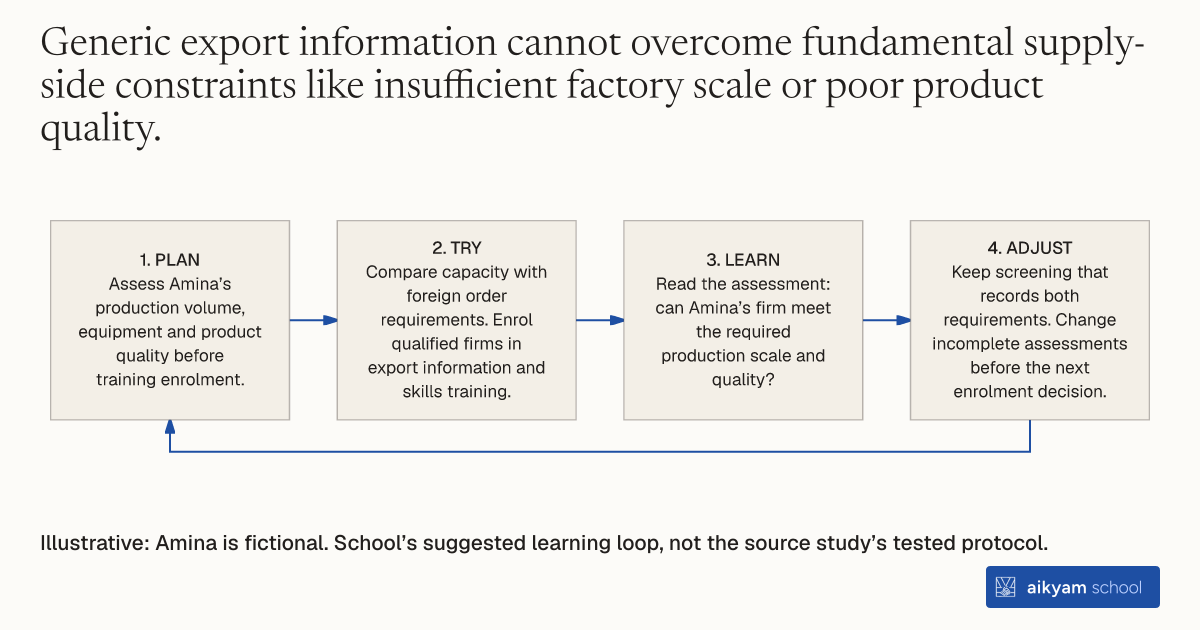
Try, learn and adjust
Check production capacity before export training
- Plan: Assess Amina’s production volume, equipment and product quality before training enrolment.
- Try: Compare capacity with foreign order requirements. Enrol qualified firms in export information and skills training.
- Learn: Read the assessment: can Amina’s firm meet the required production scale and quality?
- Adjust: Keep screening that records both requirements. Change incomplete assessments before the next enrolment decision.
Illustrative: Amina is fictional. School’s suggested learning loop, not the source study’s tested protocol.
See source →School’s suggested, untested loop. Observe capacity and quality assessments. Training alone did not change small-firm export behaviour in the studies.
How
When to use
Small enterprise owners in lower-income countries often receive generic export training seminars that fail to increase foreign sales. Micro and small firms lack the baseline production capacity and product quality required to fulfill foreign buyer demands, rendering basic export information ineffective. Screening applicant firms for minimum operational scale ensures that export training resources target businesses capable of entering foreign markets.
Screen small and medium enterprises for baseline production capacity and product quality before enrolling them in export training initiatives.
- Program administrators advertise export promotion and management training initiatives to local small business owners.
- Administrators assess applicant firms' current production volume, equipment capacity, and product quality standards.
- Assessors filter out microenterprises that lack the operational scale to meet foreign buyer order sizes.
- Program trainers deliver specialized export information and skills training to qualified, larger small-and-medium enterprises.
- Participating larger firms utilize the export information to adopt exporting activities and expand international sales.
Why it works
Targeting export training to larger firms with existing production capacity allows managers to convert new export skills into actual foreign sales.
Example
In Vietnam and Colombia, export training seminars failed to change export behaviors among small enterprises, but larger firms in Vietnam with sufficient production capacity and product quality successfully increased exports after the training.
About the study
Participants
Small and medium enterprise owners and managers in Vietnam and Colombia.
Study Design
Randomized Controlled Trials (RCTs) evaluating firm behavior adoption following export promotion seminars.
Results
Export training seminars did not result in small enterprises adopting export behaviors; only larger firms in the Vietnam trial exported more afterward because smaller firms lacked the required production capacity and quality.