Research survey
Track job search every two weeks
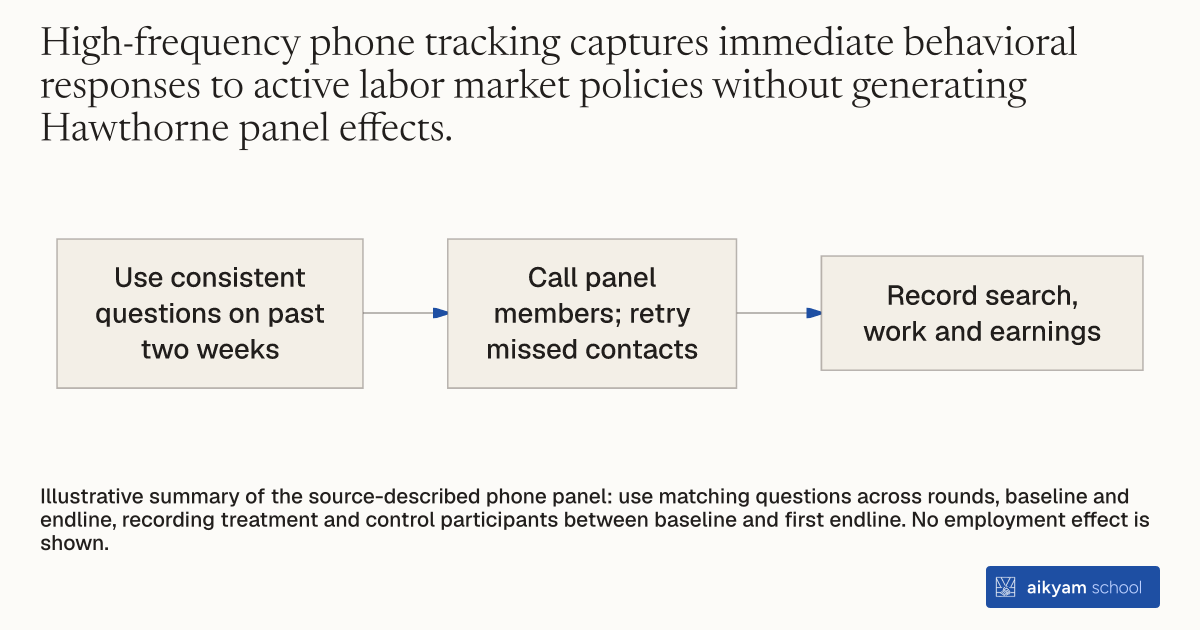
- Use consistent questions on past two weeks
- Call panel members; retry missed contacts
- Record search, work and earnings
Illustrative summary of the source-described phone panel: use matching questions across rounds, baseline and endline, recording treatment and control participants between baseline and first endline. No employment effect is shown.
See source →How
When to use
Long-term labor market evaluations relying solely on infrequent endline surveys suffer from recall bias and cannot capture high-frequency search dynamics. Rapid labor flows among urban youth cause respondents to forget short employment spells or application attempts. Administering brief phone questionnaires tracks real-time behavioral adjustments without relying on long retrospective recall windows.
Collect longitudinal panel data on individual job search effort and employment outcomes by administering brief fortnightly phone questionnaires.
- Construct a standardized short questionnaire covering active search steps, vacancy board visits, job applications, work hours, and earnings over the preceding two weeks.
- Maintain consistent question phrasing across all telephone rounds to match baseline and endline face-to-face survey instruments.
- Call every enrolled panel member once every two weeks throughout the intervention and immediate post-treatment period.
- Attempt repeated calls at different times of day to reach participants who miss initial phone contacts.
- Record fortnightly labor search indicators and employment status changes across treatment and control cohorts.
Why it works
Short biweekly recall periods produce reliable, high-resolution data on application rates, search intensity, and job turnover.
Example
Researchers conducted fortnightly phone interviews with 3,052 young job-seekers in Addis Ababa, Ethiopia over a one-year period. Surveyors tracked biweekly search steps and vacancy board visits, keeping monthly survey attrition below 5% in early months and maintaining over 90% contact rates in the final month.
About the study
Participants
N = 3,052 young job-seekers aged 18–29 in Addis Ababa, Ethiopia tracked via fortnightly phone interviews.
Study Design
High-frequency phone panel survey administered every two weeks between baseline and first endline, using quadratic trend models to track impact trajectories.
Results
Phone panel tracking revealed that transport subsidies increased search probability by 12.5% and central job board visits by 9 percentage points during active treatment, while maintaining phone contact with over 90% of respondents in the final month.