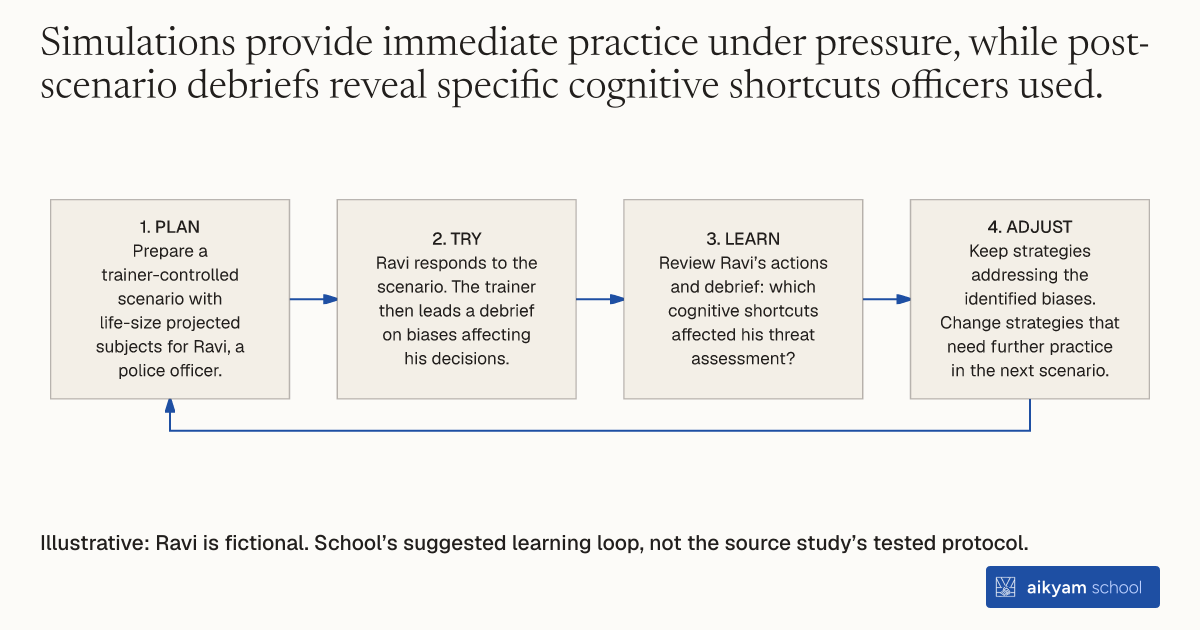
Try, learn and adjust
Use debriefs to guide the next simulation
- Plan: Prepare a trainer-controlled scenario with life-size projected subjects for Ravi, a police officer.
- Try: Ravi responds to the scenario. The trainer then leads a debrief on biases affecting his decisions.
- Learn: Review Ravi’s actions and debrief: which cognitive shortcuts affected his threat assessment?
- Adjust: Keep strategies addressing the identified biases. Change strategies that need further practice in the next scenario.
Illustrative: Ravi is fictional. School’s suggested learning loop, not the source study’s tested protocol.
See source →School’s suggested, untested loop. Observe scenario actions and biases identified in debriefs. This is not evidence of field effects.
How
When to use
Officers face high-stress, rapidly changing encounters where misjudging threats leads to unnecessary force or officer injury. Interactive simulations let officers experience realistic scenario branches without real-world danger. This method combines screen-based simulation with instructor debriefing to identify cognitive biases and practice calibrated responses.
Conduct interactive simulator scenarios with real-time trainer control and follow with structured debriefing meetings.
- Instructors project life-size scenario subjects onto screens controlled by a trainer operating the simulator.
- Trainers direct officers to respond to simulated policing scenarios designed to be potentially threatening.
- Instructors debrief officers after each simulation scenario.
- Trainers lead officers to identify cognitive biases that impacted their decision-making during the exercise.
- Instructors guide officers to develop strategies to mitigate those cognitive biases in future encounters.
Why it works
This reflection helps officers adjust force levels accurately as scenario threats change.
Example
Officers in Chicago completed interactive simulation scenarios with life-size projected subjects managed by a trainer. After each scenario, trainers led debriefing sessions where officers identified cognitive biases affecting their actions and practiced strategies to refine threat assessments.
About the study
Participants
2,070 eligible police officers with two or more years of service from all 22 Chicago Police Department districts and specialized units, randomly assigned to 1,059 treatment officers and 1,011 comparison officers.
Study Design
Randomized controlled trial grouping officers by unit and shift time, comparing Sit-D trained officers against control officers taking standard department courses using lab tasks and administrative field records over a one-year period.
Results
Trained officers reduced nonlethal use of force by 23 percent from 38.12 to 29.25 incidents per 1,000 officers per month and discretionary arrests by 23 percent from 36.85 to 28.38 per 1,000 officers per month. Discretionary arrests of Black civilians fell 28 percent from 31.26 to 22.41 per 1,000 officers per month, and injury-related absence days dropped from 1.179 to 0.607 days per month.