Research assessment
Assess decisions four months after training
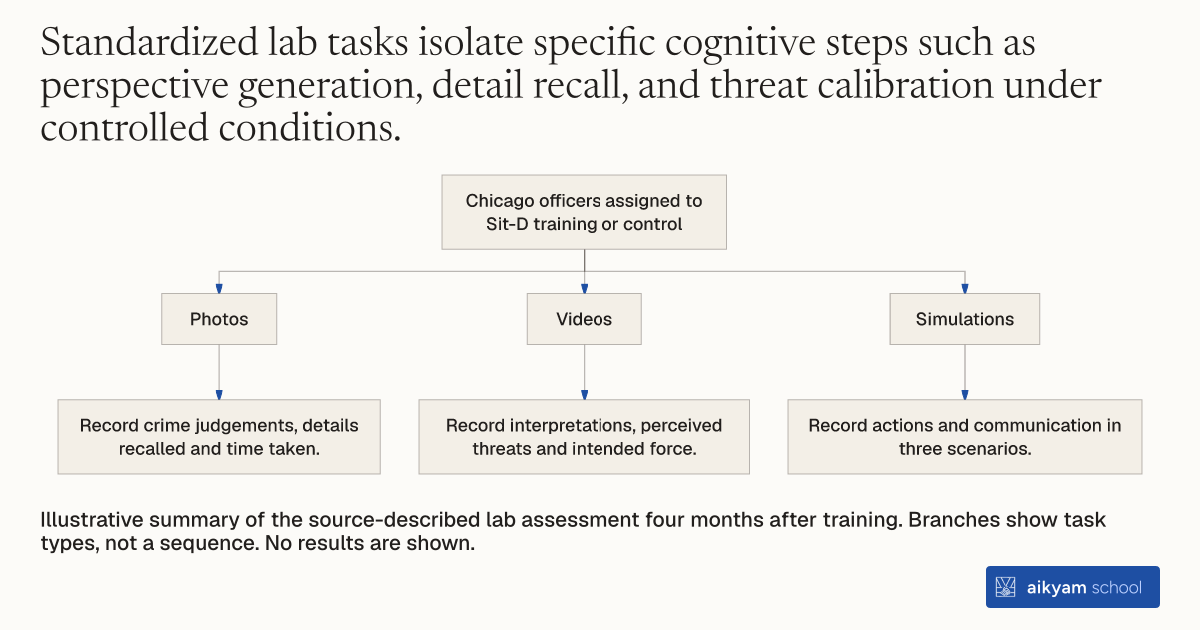
Chicago officers assigned to Sit-D training or control
- Photos
- Record crime judgements, details recalled and time taken.
- Videos
- Record interpretations, perceived threats and intended force.
- Simulations
- Record actions and communication in three scenarios.
Illustrative summary of the source-described lab assessment four months after training. Branches show task types, not a sequence. No results are shown.
See source →How
When to use
Evaluating police field performance alone makes it difficult to measure underlying cognitive processes and changes in threat assessment. Field administrative records do not capture how officers evaluate ambiguous scenes or alter intended force as threats de-escalate. This method uses structured photo, video, and simulation lab tasks to directly measure officer decision-making and cognitive processing.
Assess officer decision-making and cognitive processing through a standardized suite of lab tasks four months after training.
- Evaluators present officers with ambiguous photos in a Pictures Task where officers choose whether a crime is occurring and list supporting and unsupporting features.
- Researchers measure the time officers take and the number of alternative features recalled during the picture evaluation.
- Evaluators show officers ambiguous video scenes in a Driver's Actions Task to record all generated interpretations of subject behavior.
- Researchers show officers Use of Force Videos depicting evolving threat scenarios and record perceived threat levels and intended force.
- Evaluators record officer actions and communication during three Force Option Simulator scenarios designed to be potentially threatening.
Why it works
This testing reveals whether training changed internal thought habits before those habits manifest in field actions.
Example
Researchers assessed Chicago police officers four months after assignment to Sit-D training or control groups using photo, video, and simulation lab tasks. Trained officers generated more diverse interpretations on the driver task, recalled more alternative details on the photo task, and lowered intended force as video threats diminished.
About the study
Participants
2,070 eligible police officers with two or more years of service from all 22 Chicago Police Department districts and specialized units, randomly assigned to 1,059 treatment officers and 1,011 comparison officers.
Study Design
Randomized controlled trial grouping officers by unit and shift time, comparing Sit-D trained officers against control officers taking standard department courses using lab tasks four months post-training.
Results
Trained officers generated a more diverse set of interpretations on the Driver's Actions Task, recalled more supporting details for unchosen interpretations on the Pictures Task, performed the picture task faster, and adjusted force levels downward as subject threats decreased in videos. During simulations, trained officers fired more accurately when subjects posed direct threats without increasing overall firing rates.