Research steps
Track reports through frontline health workers
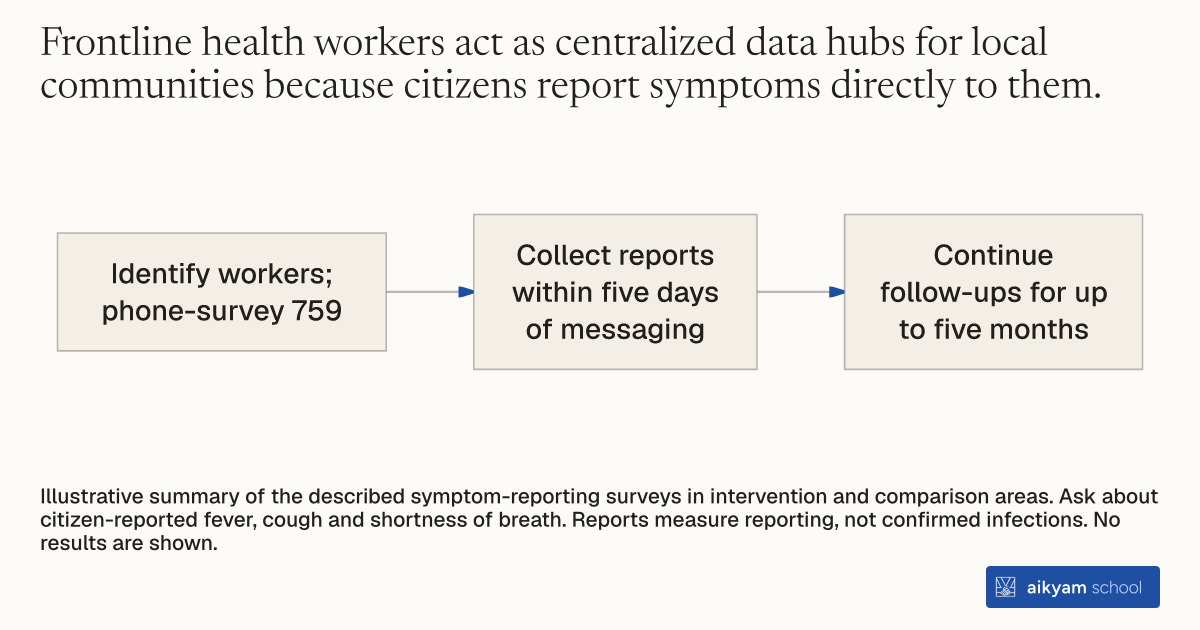
- Identify workers; phone-survey 759
- Collect reports within five days of messaging
- Continue follow-ups for up to five months
Illustrative summary of the described symptom-reporting surveys in intervention and comparison areas. Ask about citizen-reported fever, cough and shortness of breath. Reports measure reporting, not confirmed infections. No results are shown.
See source →How
When to use
During disease outbreaks, public health researchers need reliable ways to track community symptom reporting across broad geographic areas. Direct household surveying during a pandemic is costly and creates infection risks for survey teams. Researchers and health authorities can survey frontline community health workers to measure changes in community-level symptom reporting.
Survey frontline health workers to track citizen-reported symptoms across geographical units.
- Research teams identify frontline community health workers operating within designated postal index areas.
- Surveyors contact a sample of 759 community health workers by phone across intervention and comparison areas.
- Surveyors ask community health workers to report recent citizen cases of fever, cough, or shortness of breath.
- Surveyors collect initial symptom data within five days of public health message delivery.
- Surveyors conduct continuous follow-up surveys with community health workers up to five months later to track long-term reporting trends.
Why it works
Surveying these workers provides rapid, aggregated symptom data without conducting expensive door-to-door household interviews.
Example
In West Bengal, India, researchers surveyed 759 community health workers across postal index areas to measure the impact of a public health video campaign. Within five days, health workers in treatment areas recorded 23 more cases of fever and 18 more cases of coughing than health workers in comparison areas.
About the study
Participants
759 frontline health workers across rural and urban postal index areas serving 28 million phone network subscribers in West Bengal, India.
Study Design
A randomized evaluation collecting phone survey data from community health workers within five days of an intervention and continuously for up to five months.
Results
Within five days, surveyed health workers recorded 23 more fever cases (an 81.4 percent increase) and 18 more coughing cases (a 90.2 percent increase) in video message areas compared to control areas, with elevated fever reporting persisting three months later.