Research procedure
Track monthly health and work reports
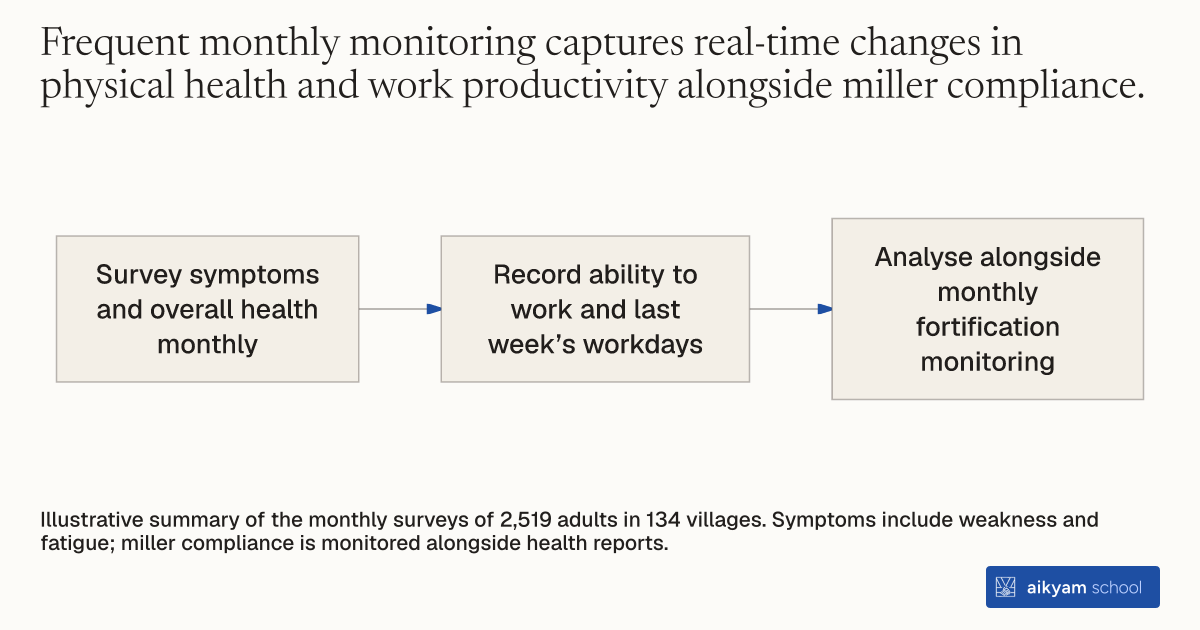
- Survey symptoms and overall health monthly
- Record ability to work and last week’s workdays
- Analyse alongside monthly fortification monitoring
Illustrative summary of the monthly surveys of 2,519 adults in 134 villages. Symptoms include weakness and fatigue; miller compliance is monitored alongside health reports.
See source →How
When to use
Rural development interventions often need to track subtle health improvements and economic productivity changes over time. Infrequent surveys miss short-term fluctuations in physical symptoms and work patterns among poor villagers. Monthly individual health and work schedule monitoring tracks health trends, labor output, and program execution across rural communities.
Survey adult community members monthly to record individual physical symptoms, self-reported health, and recent labor activity.
- Surveyors visit targeted rural households each month throughout the study period.
- Surveyors ask individual participants to report physical symptoms, including weakness and fatigue experienced during the month.
- Surveyors collect self-reported overall health status from each individual respondent.
- Surveyors record individual work schedules, including ability to work and actual days worked during the preceding week.
- Surveyors monitor local miller compliance monthly to track fortification delivery alongside participant health data.
- Researchers analyze monthly symptom and labor data against fortification uptake to evaluate intervention impact over time.
Why it works
This allows researchers to link health improvements directly to periods of high program participation.
Example
In 134 rural villages in Udaipur District, India, researchers collected monthly data on health symptoms, self-reported health, and weekly work schedules from 2,519 adults, revealing that weakness and fatigue decreased during periods of high fortification take-up but returned to baseline when take-up dropped to 30 percent at endline.
About the study
Participants
2,519 adults in 134 rural villages in Udaipur District, Rajasthan, India, where over 40 percent of households lived below the poverty line.
Study Design
Randomized evaluation across 134 villages (68 treatment and 66 comparison) with monthly longitudinal surveys tracking individual symptoms, labor supply, and miller compliance over time.
Results
Monthly surveys revealed significant reductions in weakness and fatigue symptoms when program uptake peaked above 60 percent, but showed no difference in health or work outcomes at endline when flour fortification fell to 30 percent.