Research steps
Survey before and after information
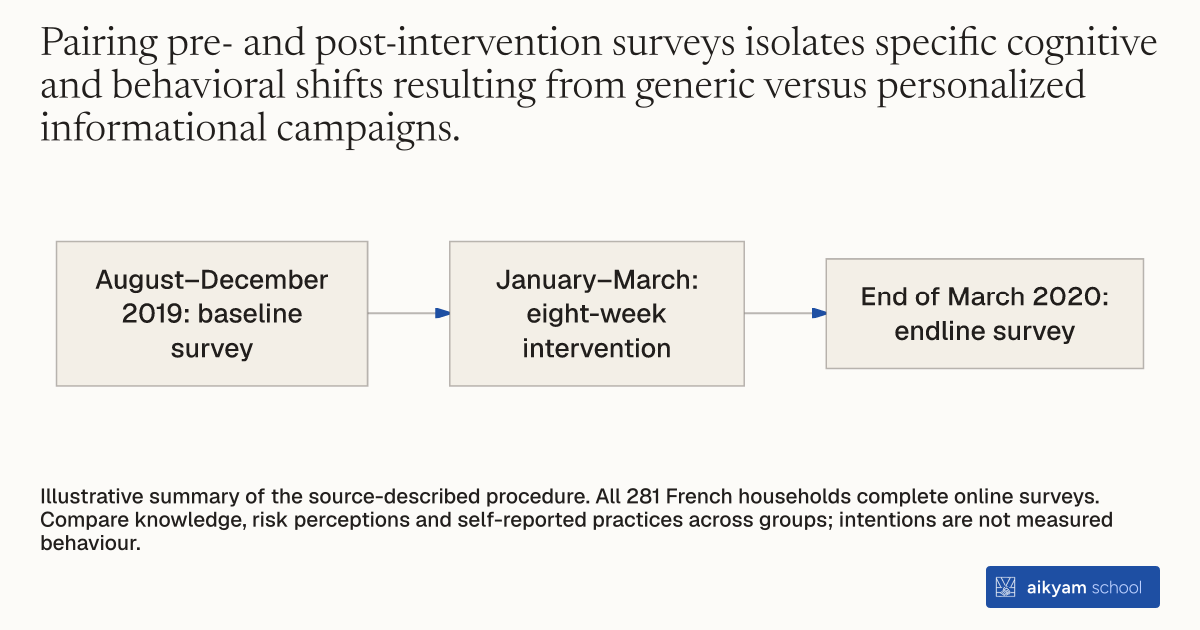
- August–December 2019: baseline survey
- January–March: eight-week intervention
- End of March 2020: endline survey
Illustrative summary of the source-described procedure. All 281 French households complete online surveys. Compare knowledge, risk perceptions and self-reported practices across groups; intentions are not measured behaviour.
See source →How
When to use
Evaluating whether an informational campaign changes public understanding or behavioral habits requires systematic data collection before and after treatment. Self-reported survey data complements physical air monitoring by capturing changes in hazard knowledge, health risk perceptions, and intended combustion practices.
Administer pre- and post-intervention online questionnaires to evaluate changes in participant knowledge, risk perceptions, and self-reported practices.
- Administer a baseline online survey to all participating households between August and December before starting interventions.
- Formulate survey questions measuring broad air pollution knowledge, specific wood-burning awareness, and self-reported heating practices.
- Deliver an eight-week educational and feedback intervention to target household groups between January and March.
- Administer an endline online survey to all households at the end of March following intervention completion.
- Compare baseline and endline survey responses across groups to evaluate shifts in pollution source identification, health risk perceptions, and burning intentions.
Why it works
This reveals whether interventions alter underlying hazard knowledge, personal risk perceptions, or intended behaviors.
Example
Researchers administered online pre-surveys between August and December 2019 and post-surveys in March 2020 to 281 French households. Post-survey data showed both generic and personalized information increased identification of wood burning as a main pollutant source by 50 percent, but neither altered perceived health risks.
About the study
Participants
N = 281 wood-heating households in France completing baseline and endline online surveys.
Study Design
Randomized controlled trial using online pre-surveys administered between August and December 2019 and post-surveys in March 2020 measuring broad pollution knowledge, wood-burning awareness, self-reported practices, and regulation support across three experimental groups.
Results
Post-surveys revealed a 50 percent increase in citing wood burning as a primary PM2.5 source and a 12 percentage point reduction in intentions to burn wood weekly or less, but showed no change in health risk perceptions or regulation support.