Try, learn and adjust
Check home assessments lead to an actionable plan
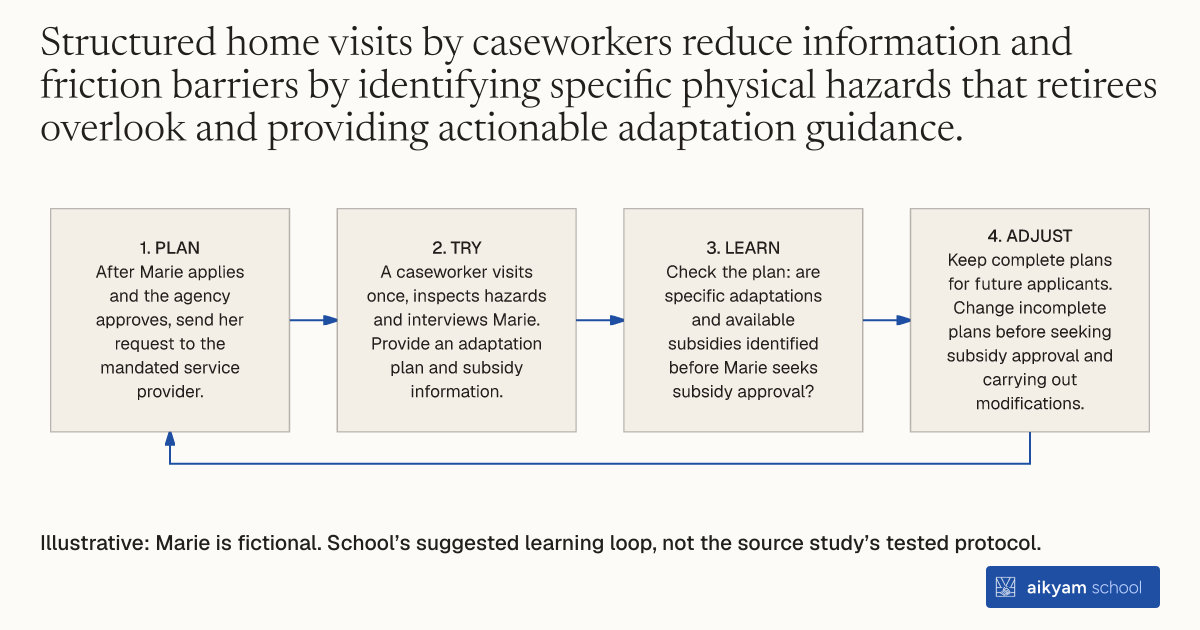
- Plan: After Marie applies and the agency approves, send her request to the mandated service provider.
- Try: A caseworker visits once, inspects hazards and interviews Marie. Provide an adaptation plan and subsidy information.
- Learn: Check the plan: are specific adaptations and available subsidies identified before Marie seeks subsidy approval?
- Adjust: Keep complete plans for future applicants. Change incomplete plans before seeking subsidy approval and carrying out modifications.
Illustrative: Marie is fictional. School’s suggested learning loop, not the source study’s tested protocol.
See source →School’s suggested, untested loop. Observe the home visit, adaptation plan and subsidy approval before modifications; do not repeat the one-off visit as a required cycle.
How
When to use
Elderly retirees often face serious risks of home falls and loss of self-sufficiency, yet demand for preventive home adaptations remains extremely low. This method provides structured individual diagnostic assessments to identify environmental hazards and specify needed home modifications for older adults. It is designed for social security agencies or senior care organizations supporting independent living among retirees.
Send a trained caseworker to perform an in-home evaluation and recommend tailored housing modifications for elderly retirees.
- The retiree submits an application to the social department of the pension agency to join the prevention program.
- The agency approves the application and transmits the request to a mandated service provider network.
- A trained caseworker visits the participant's home once to inspect the living environment and interview the retiree about specific physical needs.
- The caseworker identifies environmental barriers and recommends specific safety adaptations such as grab bars, stair-rails, ramps, or step alterations.
- The caseworker provides a detailed plan outlining recommended technical alterations and available means-tested financial subsidies.
- The participant applies to the local program manager to obtain subsidy approval before executing the home modifications.
Why it works
This helps retirees preserve self-sufficiency and reduce the risk of fall-related disability.
Example
In Île-de-France, the CNAV social department offered in-home caseworker visits across 350,000 annual PAP participants, resulting in 15,000 retirees (around 4%) accepting home adaptations.
About the study
Participants
48,090 retired individuals living in Île-de-France (Paris region), France, including a randomized brochure sample of 42,079 people.
Study Design
Randomized controlled trial (field experiment) conducted by CNAV and researchers sending 14 brochure variations in three mailing waves to evaluate program registration over a 17-month follow-up period.
Results
In the benchmark control group, baseline program registration was 0.93%, while offering full subsidy and clear instructions raised take-up by 0.77 to 0.87 percentage points (reaching up to 1.8%).