Research overview
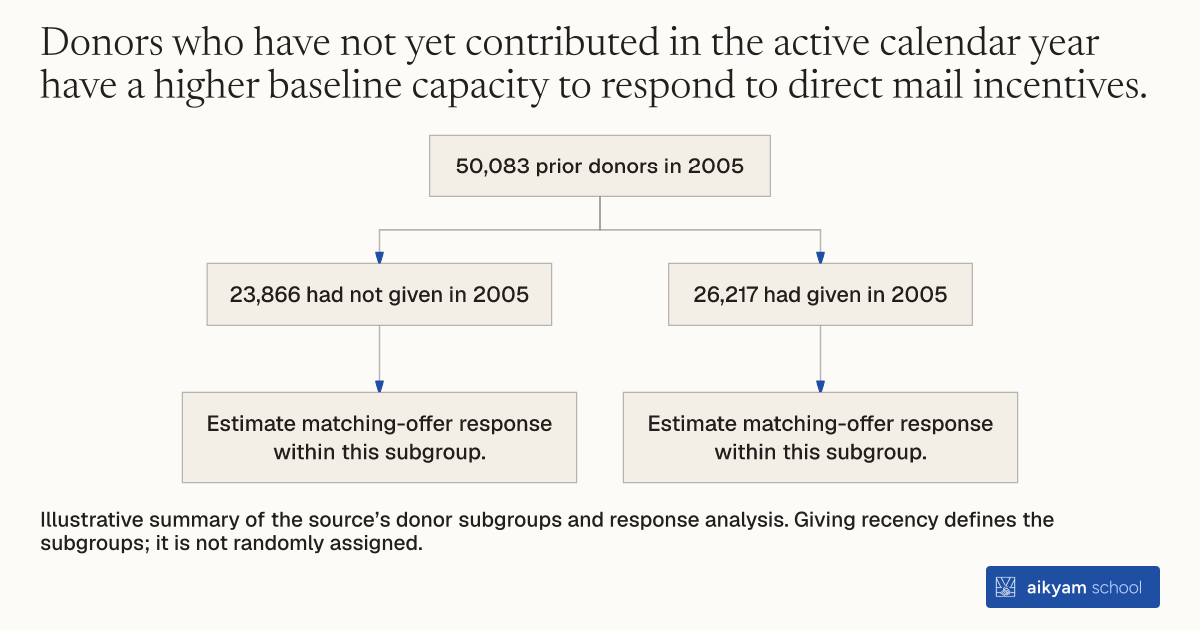
Compare giving recency
50,083 prior donors in 2005
- 23,866 had not given in 2005
- Estimate matching-offer response within this subgroup.
- 26,217 had given in 2005
- Estimate matching-offer response within this subgroup.
Illustrative summary of the source’s donor subgroups and response analysis. Giving recency defines the subgroups; it is not randomly assigned.
See source →How
When to use
Charities re-solicit past donors multiple times per year, creating variation in donor activity between those who have already given in the current calendar year and those who have not. Determining how financial incentives interact with donor giving recency helps fundraisers decide when and to whom matching grant offers should be targeted. Segmenting by calendar year giving activity ensures matching funds are used where they generate the highest lift.
Segment direct mail fundraising lists based on donor contribution timing within the active calendar year.
- Extract annual contribution records for all prior donors in the organization's database.
- Identify past donors who have not yet made a contribution in the current calendar year.
- Identify past donors who have already made at least one contribution in the current calendar year.
- Direct matching grant solicitation letters primarily to prior donors who have not yet given in the current calendar year.
- Send standard non-matched appeal letters to prior donors who have already contributed earlier in the current calendar year.
- Compare response rates and revenue per letter between current-year non-donors and current-year repeat donors.
Why it works
The matching grant offer provides the required impulse to convert uncommitted past supporters into active current-year donors.
Example
A civil liberties nonprofit in the United States evaluated matching grant direct mail solicitations sent to 50,083 prior donors, dividing them into 23,866 subjects who had not yet given in 2005 and 26,217 subjects who had already given in 2005. The matching grant treatment had a larger impact on response rate among donors who had not yet given in 2005 (0.005 marginal effect, p < 0.05) than among those who had already donated in 2005 (0.003 marginal effect, p < 0.05).
About the study
Participants
50,083 prior donors to a US civil liberties nonprofit, split into 23,866 donors who had not given in 2005 and 26,217 donors who had given in 2005.
Study Design
Subsample probit regressions evaluating direct mail matching treatment effect coefficients split by donor contribution activity within the current calendar year.
Results
Probit regressions showed a marginal effect on donation probability of 0.005 (p < 0.05) for prior donors who had not yet given in 2005 versus 0.003 (p < 0.05) for prior donors who had already given in 2005.