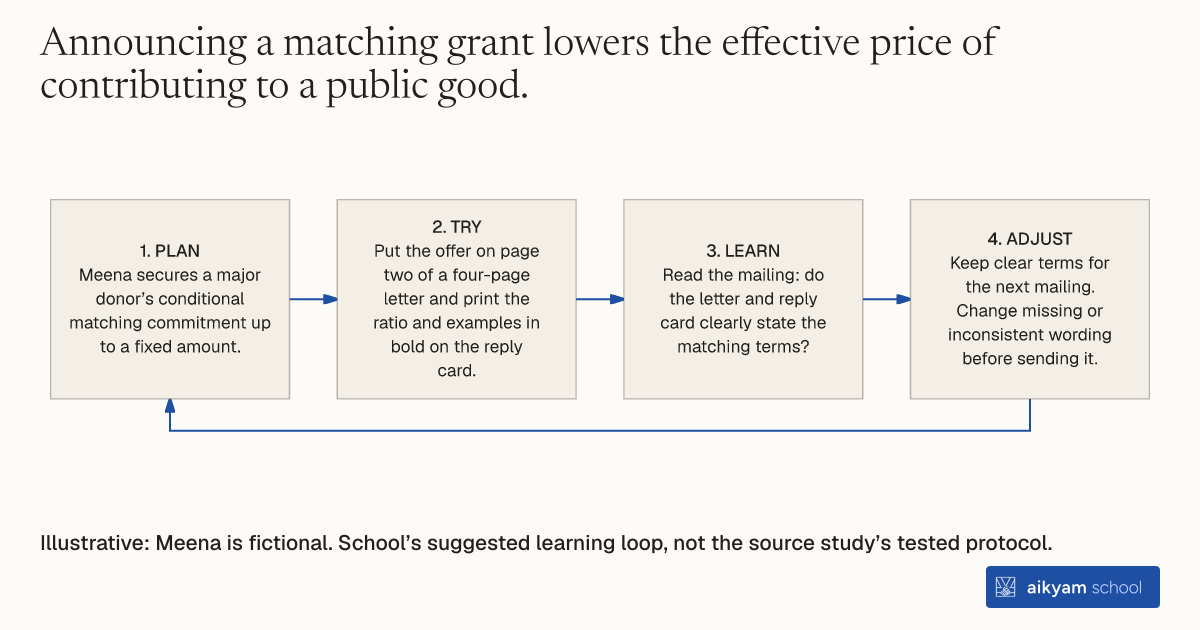
Try, learn and adjust
Check the matching offer is clear in the mailing
- Plan: Meena secures a major donor’s conditional matching commitment up to a fixed amount.
- Try: Put the offer on page two of a four-page letter and print the ratio and examples in bold on the reply card.
- Learn: Read the mailing: do the letter and reply card clearly state the matching terms?
- Adjust: Keep clear terms for the next mailing. Change missing or inconsistent wording before sending it.
Illustrative: Meena is fictional. School’s suggested learning loop, not the source study’s tested protocol.
See source →Observe matching commitment, letter wording and reply card details. School suggests this learning loop; it is not the source’s tested procedure.
How
When to use
Charities need to raise funds from past supporters using direct mail. Standard solicitation letters often yield low response rates and modest revenue per letter. Adding a matching grant offer encourages prior donors to contribute by signaling organizational value and cause urgency.
Execute a direct mail fundraising campaign offering a matching grant to prior donors.
- Secure a conditional commitment from a major donor to match contributions from other supporters up to a fixed amount.
- Draft a four-page solicitation letter addressing a pressing political or social issue relevant to the organization.
- Insert a paragraph at the top of the second page of the letter announcing the matching grant offer.
- Print the matching gift details in bold type on the reply card, specifying the match ratio and example contribution amounts.
- Mail the solicitation letters to prior donors as part of a scheduled fundraising drive.
Why it works
The match offer also serves as a quality signal that reassures donors about the legitimacy and urgency of the cause.
Example
A civil liberties nonprofit in the United States sent fundraising letters to 33,396 past donors announcing a matching grant from a concerned member. The offer increased the response rate from 1.8 percent to 2.2 percent and raised revenue per letter from \$0.81 to \$0.97.
About the study
Participants
50,083 prior donors to a US civil liberties nonprofit, with 33,396 assigned to the match treatment and 16,687 to control.
Study Design
Natural field experiment using direct mail solicitations sent in August 2005.
Results
Announcing matching funds increased revenue per solicitation by 19 percent (from \$0.81 to \$0.97) and boosted response rate by 22 percent (from 1.8 percent to 2.2 percent).