Research procedure
Test announced matching limits
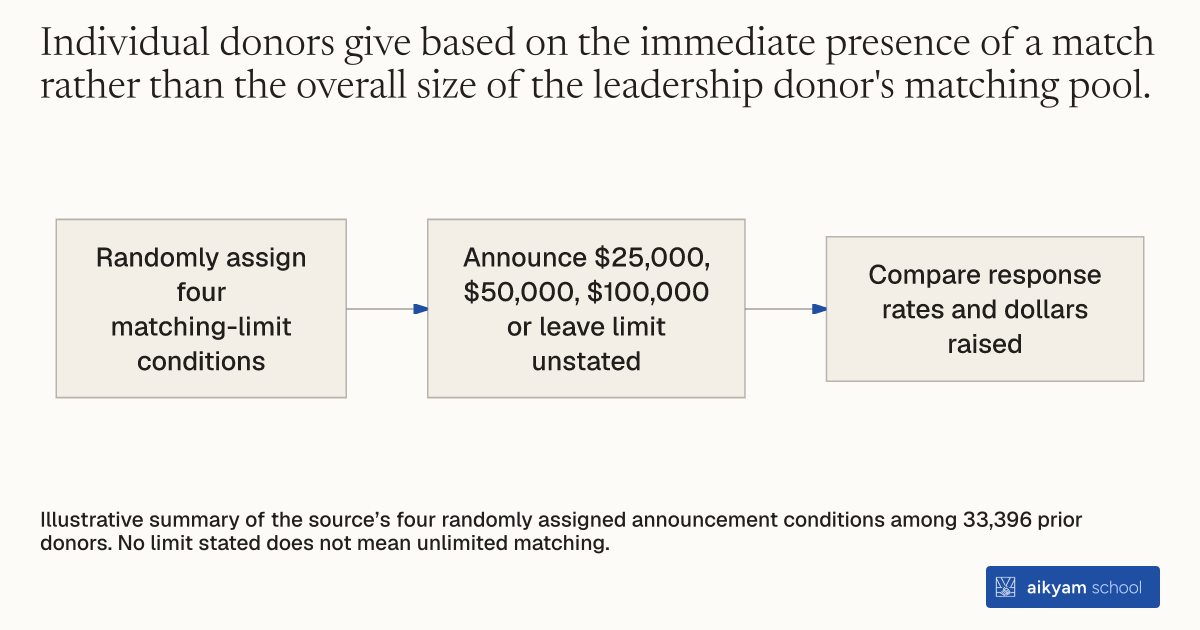
- Randomly assign four matching-limit conditions
- Announce $25,000, $50,000, $100,000 or leave limit unstated
- Compare response rates and dollars raised
Illustrative summary of the source’s four randomly assigned announcement conditions among 33,396 prior donors. No limit stated does not mean unlimited matching.
See source →How
When to use
Fundraisers often attempt to secure and announce large total matching grant caps, assuming higher overall caps signal campaign importance. Securing massive matching pools requires significant administrative effort from the charity. Testing varying match threshold caps allows nonprofits to determine whether larger announced ceilings increase donor participation or contribution amounts.
Vary the stated maximum matching grant threshold across direct mail solicitations to test donor responsiveness to total campaign match ceilings.
- Secure matching pledge commitments from leadership donors that allow announcing different total match caps.
- Divide direct mail recipients into four random treatment sub-groups.
- Assign the first sub-group a stated maximum matching grant threshold of \$25,000.
- Assign the second sub-group a stated maximum matching grant threshold of \$50,000.
- Assign the third sub-group a stated maximum matching grant threshold of \$100,000.
- Assign the fourth sub-group an unstated maximum matching grant threshold.
- Print the designated threshold amount in the second paragraph of the letter and evaluate response rates and dollars raised.
Example
A civil liberties nonprofit in the United States mailed solicitations testing \$25,000, \$50,000, \$100,000, and unstated matching thresholds to 33,396 prior donors split into four equal sub-groups of roughly 8,349 each. All four threshold conditions yielded identical 2.2 percent response rates and similar revenue per letter (\$1.06 for \$25,000, \$0.89 for \$50,000, \$0.90 for \$100,000, and \$1.01 for unstated).
About the study
Participants
33,396 prior donors to a US civil liberties nonprofit, randomly assigned into four groups of roughly 8,349 subjects per threshold treatment.
Study Design
Randomized natural field trial testing \$25,000, \$50,000, \$100,000, and unstated match maximums in direct mail letters sent in August 2005.
Results
Probit regressions showed no statistically significant effect of \$25,000, \$50,000, or \$100,000 thresholds on donation probability relative to the unstated baseline (-0.001, 0.000, and -0.000 marginal effects, with standard error 0.002 and p > 0.10).