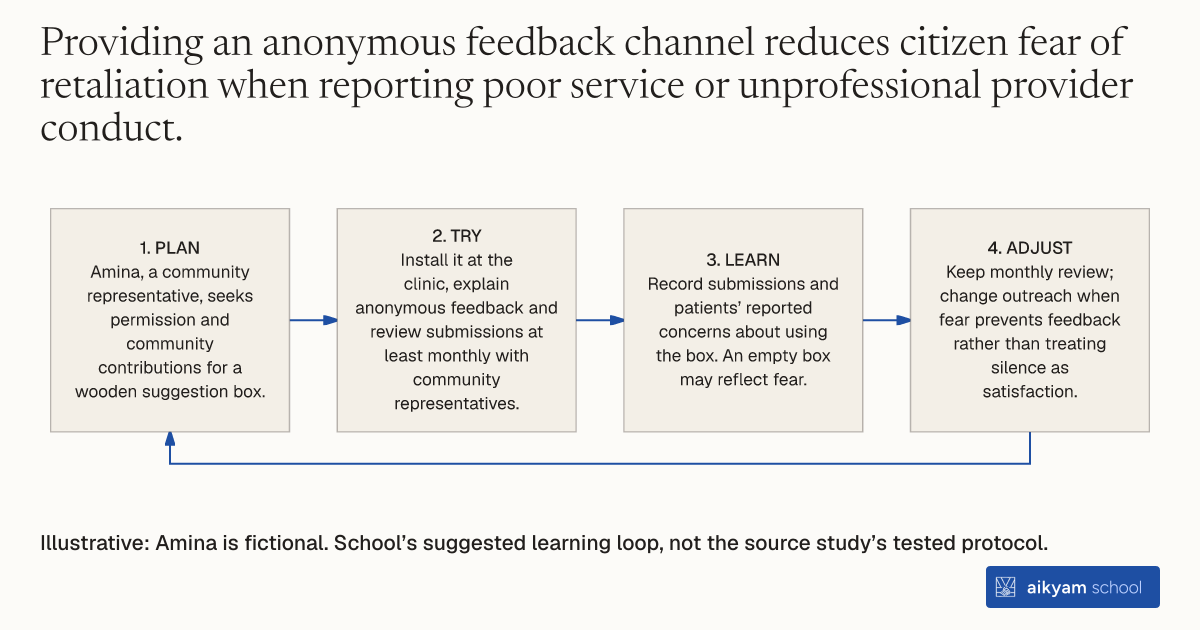
Try, learn and adjust
Check whether patients use the suggestion box
- Plan: Amina, a community representative, seeks permission and community contributions for a wooden suggestion box.
- Try: Install it at the clinic, explain anonymous feedback and review submissions at least monthly with community representatives.
- Learn: Record submissions and patients’ reported concerns about using the box. An empty box may reflect fear.
- Adjust: Keep monthly review; change outreach when fear prevents feedback rather than treating silence as satisfaction.
Illustrative: Amina is fictional. School’s suggested learning loop, not the source study’s tested protocol.
See source →Observe submissions and barriers to reporting; staff-reported effort is not proof of better care. School suggests this learning loop; it was not tested by the source.
How
When to use
Patients at rural primary health facilities experience poor service quality or rude provider behavior but hesitate to report issues directly. Community representatives need a low-cost, anonymous communication channel to collect client feedback. Organizers install this mechanism to encourage provider accountability and improve patient experiences.
Install an anonymous suggestion box at a local health facility to establish a structured patient feedback channel.
- Secure formal permission and support from village administrative authorities and health dispensary staff.
- Collect small financial contributions from community representatives to fund local construction materials.
- Construct a secure wooden box and mount it prominently inside the health facility.
- Conduct community outreach to explain the purpose of the suggestion box and instruct citizens on how to submit feedback anonymously.
- Convene community representatives at least once a month to unlock the box, review submitted feedback, and discuss responses with facility staff.
Why it works
Even when written submissions are sparse, the physical presence of a complaint box signals public oversight and prompts healthcare staff to improve their daily performance.
Example
In a Tanzanian village, community representatives each donated 1,000 TZS (approximately 0.40 USD) to construct and install a wooden suggestion box at the local dispensary to address rude staff behavior. Although the box yielded no written comments during its first monthly check because patients feared submitting notes, dispensary staff reported that its presence motivated them to work harder and improve performance.
About the study
Participants
200 rural villages across two regions in Indonesia and two regions in Tanzania, with complaint mechanisms established in 21.5% of intervention communities overall (36.0% in Tanzania and 7.0% in Indonesia).
Study Design
Randomized controlled trial evaluating a non-prescriptive social accountability initiative, collecting standardized social action plans and conducting key informant interview verification in 65 treatment villages following a 90-day implementation period.
Results
Complaint mechanisms were established in 21.5% of all intervention villages (representing 41.7% of all information and communication actions), with communities reporting a 79.5% action completion rate across the pathway within 90 days.