Try, learn and adjust
Check permission before displaying clinic fees
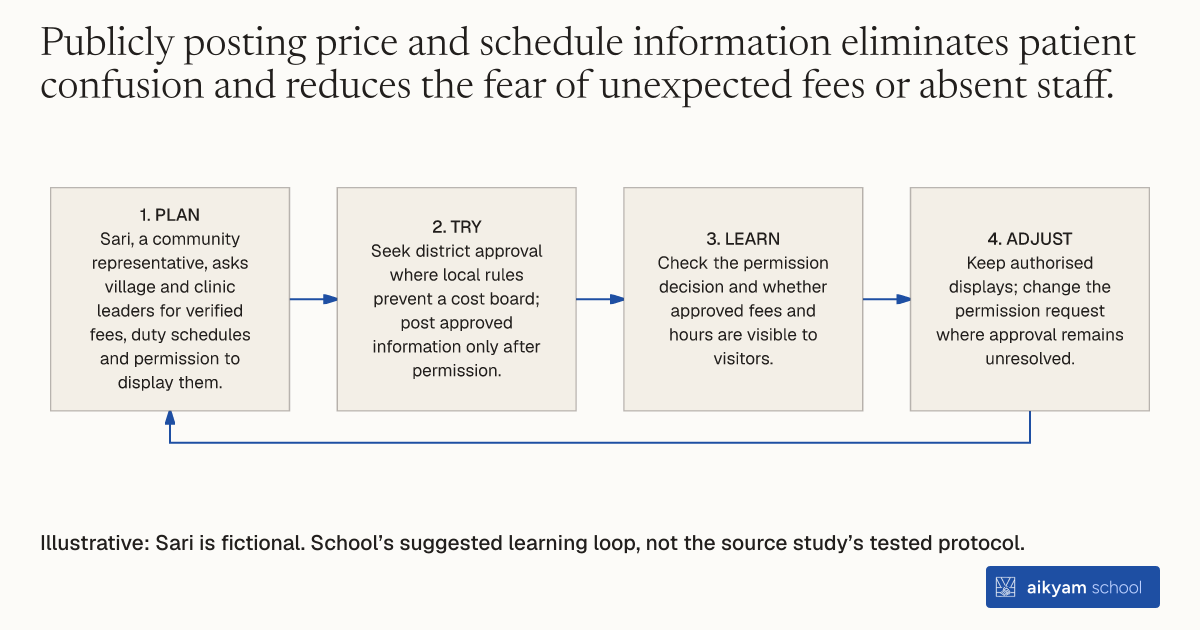
- Plan: Sari, a community representative, asks village and clinic leaders for verified fees, duty schedules and permission to display them.
- Try: Seek district approval where local rules prevent a cost board; post approved information only after permission.
- Learn: Check the permission decision and whether approved fees and hours are visible to visitors.
- Adjust: Keep authorised displays; change the permission request where approval remains unresolved.
Illustrative: Sari is fictional. School’s suggested learning loop, not the source study’s tested protocol.
See source →Observe approval and visible information. The Indonesian example describes a further request, not a completed fee board. School suggests this learning loop; it was not tested by the source.
How
When to use
Patients attending local primary health facilities often face uncertainty regarding medical service fees and clinical operating schedules. Community representatives need a clear, public mechanism to eliminate price confusion and encourage healthcare utilization. Local organizers install visible cost boards and duty schedules at clinics to increase transparency for community members.
Display clear service fee schedules and operating hours prominently at local primary health facilities to improve information transparency.
- Recruited community representatives meet with the local village headman to request a consultation with the health facility midwife or clinic head.
- Conduct an advocacy meeting with healthcare providers to present the community's request for clear cost and operating hours displays.
- Obtain official approval and verified pricing or schedule information from the district health office or local facility leadership.
- Construct or procure a public bulletin board or information sign to display at the entrance of the health facility.
- Post detailed lists of service fees, midwife duty schedules, emergency contact details, and clinic operating hours for all visitors to view.
Why it works
Visible fee displays increase accountability at the facility level and encourage hesitant citizens to seek timely care.
Example
In an Indonesian village, community representatives met with their village headman and local midwife to advocate for a cost information board at the health facility because community members feared seeking care due to uncertain costs; when the midwife noted that district rules prohibited posting costs on facility bulletin boards, the representatives designed a follow-up action to request permission directly from the district health office.
About the study
Participants
200 rural treatment villages across two regions in Indonesia (100 villages) and two regions in Tanzania (100 villages).
Study Design
Randomized controlled trial evaluating a non-prescriptive social accountability initiative, tracking social action plans and completion rates across 90 days.
Results
Information and communication actions were designed by 39.0% of communities overall (42.0% in Indonesia and 36.0% in Tanzania), with cost transparency sought in 32.0% of Indonesian villages and operating hours information in 12.0% of Indonesian villages, achieving an overall pathway completion rate of 79.5% within 90 days.