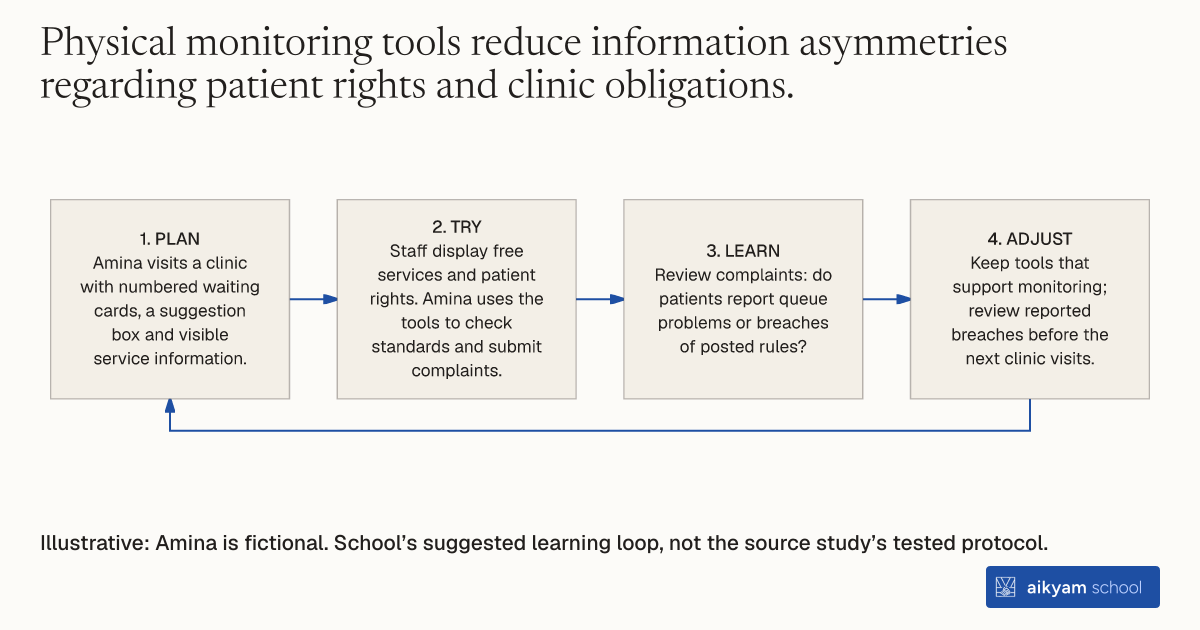
Try, learn and adjust
Check visible clinic rules and patient feedback
- Plan: Amina visits a clinic with numbered waiting cards, a suggestion box and visible service information.
- Try: Staff display free services and patient rights. Amina uses the tools to check standards and submit complaints.
- Learn: Review complaints: do patients report queue problems or breaches of posted rules?
- Adjust: Keep tools that support monitoring; review reported breaches before the next clinic visits.
Illustrative: Amina is fictional. School’s suggested learning loop, not the source study’s tested protocol.
See source →School’s suggested loop, not a tested source procedure. Observe waiting cards, posted information and complaints; these checks do not establish health effects.
How
When to use
Primary health facilities often operate without transparent procedural standards, leaving patients vulnerable to queue jumping, hidden fees, and poor service. This lack of visible performance standards prevents citizens from verifying clinic rules or submitting feedback. This method installs physical accountability tools in dispensaries to establish transparent service practices for rural clinic users.
Install physical accountability and feedback tools at primary health facilities to enable continuous beneficiary monitoring.
- Health facility staff install a suggestion box at the clinic entrance to collect anonymous patient feedback.
- Health facility staff issue numbered waiting cards to arriving patients to enforce a transparent queuing system.
- Health facility staff post a visible sign listing all free health services offered by the clinic.
- Health facility staff display a prominent poster detailing patient rights and obligations.
- Community members use these visual tools during clinic visits to verify service delivery standards and record complaints.
Why it works
They establish transparent operational norms that allow patients to monitor provider behavior directly and report non-compliance.
Example
Across 25 rural treatment health facilities in Uganda, community members and staff installed suggestion boxes, waiting cards, and rights posters. Following the intervention, the community monitoring ACTION index reached 0.42 in treatment clinics compared to -0.42 in control clinics, with the largest increases occurring in ethnically homogeneous communities.
About the study
Participants
50 public primary health dispensaries and their catchment areas across 9 rural districts in Uganda.
Study Design
Randomized field experiment evaluating community monitoring tools across 25 treatment health facilities and 25 control facilities.
Results
Post-intervention ACTION index reached 0.42 in the treatment group compared to -0.42 in the control group, representing a statistically significant difference of 0.84 (standard error 0.28).