Try, learn and adjust
Check the placenta pit project reaches handover
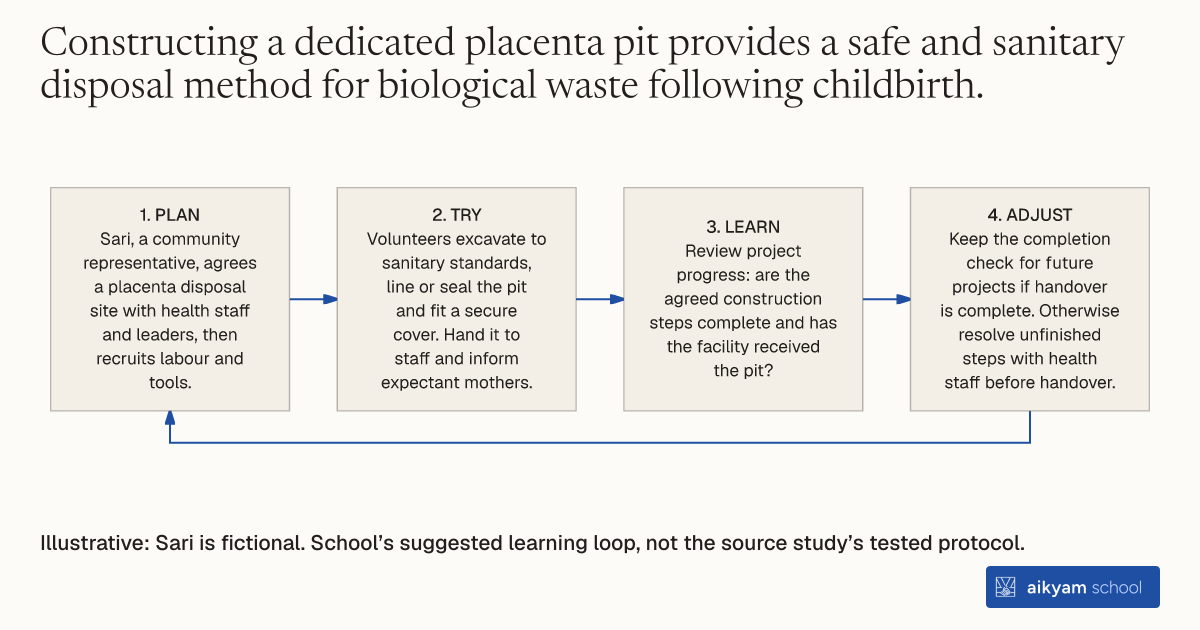
- Plan: Sari, a community representative, agrees a placenta disposal site with health staff and leaders, then recruits labour and tools.
- Try: Volunteers excavate to sanitary standards, line or seal the pit and fit a secure cover. Hand it to staff and inform expectant mothers.
- Learn: Review project progress: are the agreed construction steps complete and has the facility received the pit?
- Adjust: Keep the completion check for future projects if handover is complete. Otherwise resolve unfinished steps with health staff before handover.
Illustrative: Sari is fictional. School’s suggested learning loop, not the source study’s tested protocol.
See source →School's suggested, untested loop: observe construction progress and handover; this loop is not a sanitation specification or proof of safer births.
How
When to use
Rural primary health facilities lack hygienic, culturally appropriate disposal sites for biological waste following facility childbirth. Expectant mothers hesitate to deliver at dispensaries that lack proper disposal infrastructure for placentas. Local community organizers mobilize residents to construct placenta burial pits at health facilities to promote sanitary and culturally respectful delivery conditions.
Mobilize community members and health facility staff to dig and construct a dedicated placenta burial pit at the local health facility.
- Meet with health facility staff and village leaders to identify a suitable site on dispensary grounds for placenta disposal.
- Convene a village planning meeting to present the construction project and solicit volunteer manual labor and tools.
- Organize community work sessions where volunteers excavate a deep pit according to sanitary standards.
- Line or seal the pit structure and install a secure, hygienic cover or access hatch.
- Hand over the completed placenta pit to facility staff and inform local expectant mothers of the new sanitary amenity.
Why it works
Meeting local cultural preferences for respectful placenta disposal encourages pregnant women to choose facility births over home deliveries.
Example
In rural Tanzanian program villages, community representatives organized residents to construct placenta burial pits at local dispensaries, representing 21.4% of facility infrastructure actions in Tanzania across 6.0% of Tanzanian intervention communities.
About the study
Participants
200 rural treatment villages across two regions in Indonesia (100 villages) and two regions in Tanzania (100 villages).
Study Design
Randomized controlled trial evaluating a non-prescriptive civic deliberation initiative, tracking community action plan goals and self-reported completion over a 90-day intervention period.
Results
Placenta pit construction was designed in 3.0% of communities overall (6.0% in Tanzania and 0.0% in Indonesia), representing 7.4% of all facility infrastructure actions overall and 21.4% of facility infrastructure actions in Tanzania.